
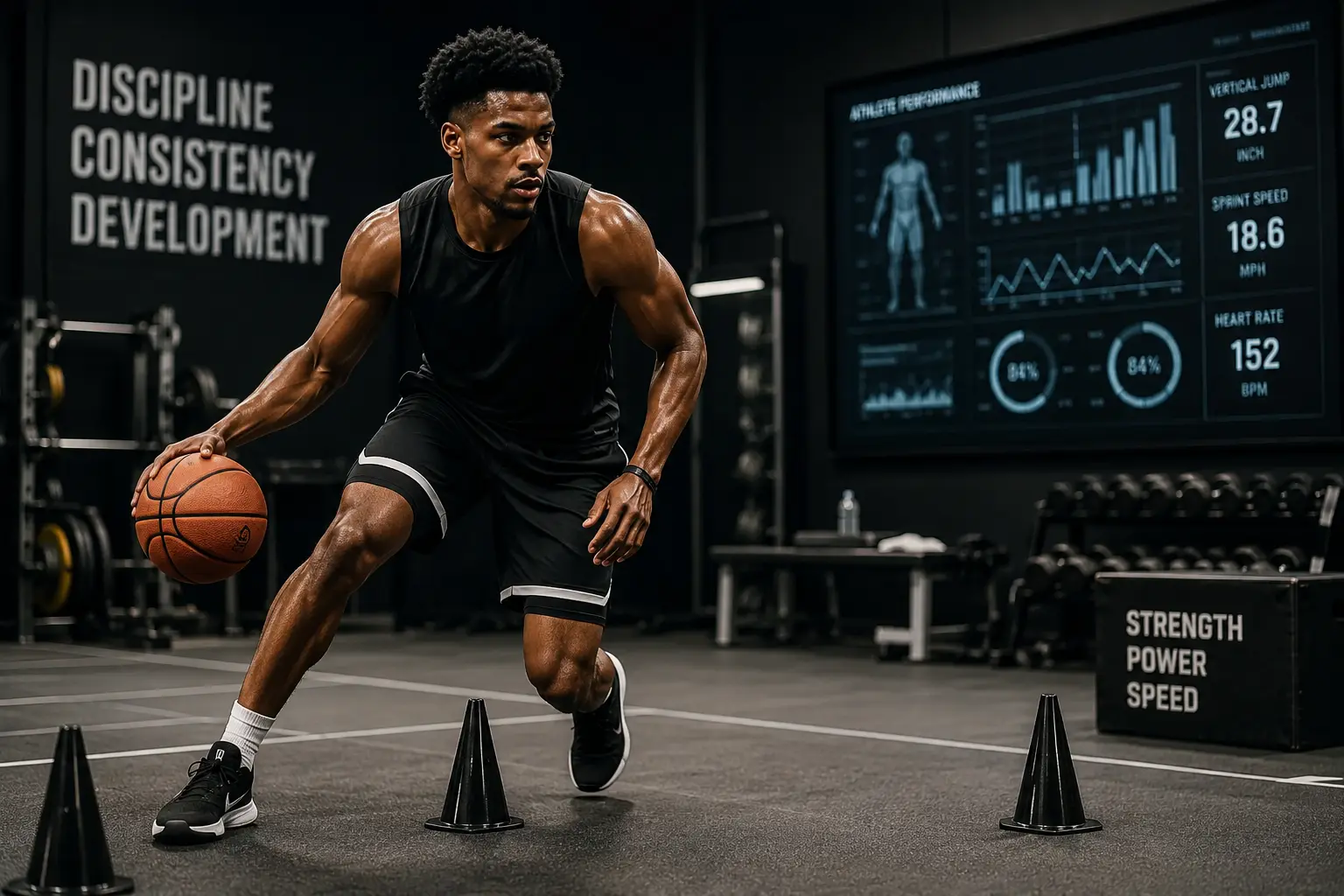

If you want to see yourself among the World’s Greatest Athletes, this is where it begins.
The time is 5:47 a.m. in Baton Rouge, La.

19-year-old wide receiver Marcus already on the field. No routes for running. Missed the ball. He is sitting completely still in a chair wearing a lightweight headband connected to a laptop as a sports scientist silently watches biofeedback readings stream across the screen.His heart rate variability. His brain activity. His sleep quality from the night before. His muscle recovery percentage from Tuesday’s practice.The science already knows, before Marcus has thrown a single ball, before he’s run a single sprint, whether today should be a full speed day or a recovery day.The science already knows, before Marcus has thrown a single ball, before he’s run a single sprint, whether today should be a full speed day or a recovery day. This is player development in 2025. And it is nothing short of revolutionary.This is how the World’s Greatest Athletes are now being built
Table of Contents
This Is How The World’s Greatest Athletes Are Now Being Bulit

So let me take you back – way back.
For much of the 20th century, athletic training in America followed a brutally simple philosophy: if you can take it, take it. Run until you can’t run no more. Raise until your arms burn. Sleep on it and try again in the morning. If you made it through you were tough. If you did not, then you just were not made for it.
That was the culture across the board from Pop Warner football programs to Division I schools to the pro level. Squeeze harder. Grind more. Do more. Always.
But in the days when sports were forged by raw talent and old school training science, many of those techniques were doing more harm than good.
Countless times they were ruining careers before they’d even started.
It wasn’t a dramatic announcement or a sudden change in the rules. It arrived silently through the patient work of scientists, physiologists, performance coaches and sports psychologists who dared ask a dangerous question.
What if it was more important to train smarter, not harder?
That single question became the foundation for modern player development and training science—and the answers changed sports forever.
The Man Who Rewired How We Think About The World’s Greatest Athletes
Before the data, before the wearables, before AI-driven workout apps—there was a professor at the University of Illinois named Coleman Griffith.
Griffith was born in 1893 in a small town in Iowa. He became a psychology professor, not a football coach. But somewhere between his academic work and his fascination with human performance, he stumbled into a field that didn’t even have a name yet.
In 1925, he published “Psychology and Its Relation to Athletic Competition.” A year later, he followed it with “The Psychology of Coaching.” These weren’t training manuals. They were scientific explorations of what actually happens inside an athlete’s mind—the focus, the fear, the pressure, the confidence.
In 1938, the Chicago Cubs hired him as their sports psychologist. At a baseball game. In 1938. This was so far ahead of its time that the players reportedly didn’t know what to make of him.
But Griffith understood something that the coaches around him didn’t. The brain and the body are not separate systems. What happens upstairs—the stress, the self-doubt, and the mental fatigue—shows up directly in how fast you run, how accurately you throw, and how quickly you react.
Coleman Griffith is now called the father of American sports psychology. He didn’t get famous during his lifetime. But every sports scientist, strength coach, and performance analyst working in America today is standing on ground he broke.
The Science That Builds the World’s Greatest Athletes Today

Fast-forward to 2025, and the field Griffith pioneered has exploded into something unrecognizable.
Here’s what modern player development and training science actually looks like and why it matters for every athlete in America.
Wearable Technology & How the World’s Greatest Athletes Monitor Their Bodies in Real Time
Today athletes wear devices smaller than a quarter that track everything in real time. Heart rate, blood oxygen, ground contact time, movement load, acceleration, deceleration – all of it, every second of every practice.
Companies such as Catapult Sports have developed platforms that merge this data with video, giving coaches and scientists a complete picture of what each player is doing and how their body is responding. The result? Training decisions that used to be based on gut feeling are now based on evidence.
My opinion? This is the single greatest shift in sports history since the forward pass. Coaches can now see fatigue before the athlete feels it. That’s not just a performance advantage, it’s an injury prevention revolution.
AI and Machine Learning: The Hidden Force Behind the World’s Greatest Athletes
Artificial intelligence is no longer science fiction in sports. It’s Tuesday morning.
Research published in 2025 confirms that AI is fundamentally transforming sports science improving training load management, sports performance, and overall athlete well-being. Machine learning algorithms can now analyze patterns in an athlete’s movement that no human eye could detect. They predict injury risk days before a body breaks down. They identify talent in young players that traditional scouts miss entirely.
The NBA, NFL, and MLB are all using versions of this technology right now. Behind every seemingly “instinctive” roster decision, there’s increasingly a data model running in the background.
Sleep Science: The Underrated Secret of the World’s Greatest Athletes
Here’s one that still gets people when I bring it up: sleep is now regarded as a primary training tool. Not a passive recuperation. A performance of active intervention.
Sleep specialists have been hired by professional franchises. Teams monitor how long and how well athletes sleep the same way they monitor sprint times. Why? The science is indisputable. Poor sleep impairs reaction time, decision-making speed, hormone production, and muscle recovery, all the things that determine whether a player wins or loses.
Some NFL teams have redesigned their entire travel schedules to protect athlete sleep cycles. Hotels are vetted for light blackout quality and mattress specifications. Naps are scheduled like meetings.This is not soft. This is science. And the teams that do that are winning more.
Deliberate Practice: What the World’s Greatest Athletes Do Differently in Training
For decades, the popular wisdom was that it takes 10,000 hours to become world-class at anything. Practice enough, and greatness would happen.
Sports science has refined that idea significantly. Research now shows it’s not just how much you practice, it’s how you practice. Scientists call it deliberate practice: highly focused, feedback-rich repetition that targets specific weaknesses rather than reinforcing comfortable strengths.
Experts are not just more experienced, research shows, they process information in fundamentally different ways. Skilled athletes are more proficient in recognizing patterns, more effective at coding information about situations, and faster and more accurate decision makers. They’re not natural gifts. They’re learned behaviors.
Mental Conditioning: The Inner Game of the World’s Greatest Athletes
Some names that don’t get enough recognition in American sports culture: At Michigan, Brady worked with sports psychologist Greg Harden. Russell Wilson says mental conditioning coach Trevor Moawad has changed the way he approaches pressure situations. These were not PR-move relationships. They were investments in performance.
Sports psychology has transitioned from a stigmatized side conversation to a core pillar of elite player development. Visualization. Breath work. Attentional control. Pressure simulation. These are the tools of every serious development program today, from high school varsity on up to the Super Bowl.
The Scientists Who Shaped The World’s Greatest Athletes
Dr. Mark Williams, a professor at the University of Utah, has published nearly 500 articles on expertise, skill acquisition, and talent identification. He has worked directly with the NBA, NFL, MLB, FIFA & IOC. His book “The Best: How Elite Athletes Are Made” is one of the most important sports science texts of modern times. His core message is that greatness is grown through the right environments, not just raw talent.
Dr. William Kraemer, a professor at Ohio State University, has published over 450 scientific papers on strength training, resistance training, and exercise physiology. He helped develop high-intensity interval training (HIIT) techniques that millions of Americans practice at gyms every day.
Stanford University has placed Dr. Joan Duda in the top 2% of most-cited scientists in the world. Her work on motivation, self-confidence, and resilience over the decades has shaped the way coaches at all levels speak to athletes. Her empowering coaching programs are used around the world.
They are not names that are familiar in America. They ought to be. They have assisted athletes.
What This Means For Young Athletes Aspiring To Become The World’s Greatest Athletes
That’s why it matters beyond the pros.
The principles of training science, optimizing sleep, deliberate practice, mental conditioning, load management, and personalized nutrition aren’t just for NFL franchises with $10 million training facilities. They’re there for any young athlete that their coaches and parents understand.
A pitcher in high school who learns about sleep and recovery before his sophomore year will develop faster and stay healthier than a pitcher who doesn’t. A college basketball player who practices mental visualization has a measurable advantage over a player who never does when the pressure is on.
The science is there. The question is do we take it to every gym, every field, every athletic program in America, not just elite ones?
That’s really the final frontier for player development. Not the tech. The access. You can visit this site for more info https://www.masschiro.org/keep-young-athletes-healthy-and-fit/
Player Development & Training
| Area | What Science Changed |
| Physical Training | From “more is more” to load-managed, data-driven programs |
| Mental Performance | From optional add-on to central training pillar |
| Injury Prevention | From reactive treatment to predictive, AI-driven protocols |
| Nutrition | From generic guidelines to individualized fueling plans |
| Sleep | From ignored to actively managed performance tool |
| Talent Identification | From gut-feeling scouting to biometric and cognitive assessment |
| Recovery | From passive rest to structured, science-based protocols |
Frequently Asked Questions About The World’s Greatest Athletes And Training Science
Q: What exactly is training science in sports? Training science is the application of research from physiology, psychology, biomechanics, and nutrition to improve how athletes train, recover, and perform. It uses data, technology, and evidence-based methods to build better athletes more efficiently and safely.
Q: How has sports science changed player development in the USA? Dramatically. American professional teams now employ full staffs of sports scientists, performance analysts, sleep specialists, nutritionists, and psychologists. Training programs are individualized, data-driven, and far more injury-aware than they were even 15 years ago.
Q: What role does AI play in modern athlete training? AI helps sports scientists analyze movement patterns, predict injury risk, identify talent, and personalize training loads. Machine learning algorithms process data from wearable sensors to give coaches real-time feedback that human observation alone could never provide.
Q: Is mental conditioning really as important as physical training? Yes — and science backs this up strongly. Research confirms that elite athletes process information faster, manage pressure more effectively, and make better decisions under stress because of trained mental skills, not just innate talent. Sports psychology is now a core component of player development at every serious level.
Q: What is deliberate practice and why does it matter? Deliberate practice means highly focused, feedback-rich training that targets specific weaknesses rather than repeating things you’re already good at. Research consistently shows it’s the quality and structure of practice, not just the hours, that separates elite performers from the rest.
Q: How important is sleep in athlete development? Critically important. Sleep is when muscle tissue repairs, growth hormones are released, and skill memories are consolidated in the brain. Professional teams now actively manage and monitor athlete sleep because even small deficits measurably hurt performance, reaction time, and injury resistance.
Q: Can high school or college athletes benefit from training science? 100%. The fundamental principles of deliberate practice, optimizing sleep, mental conditioning and recovery management are available at all levels. The science doesn’t need expensive equipment. It takes knowledge, intention, and consistency.
Q: Who is considered the father of sports psychology in America? In the 1920s, many consider Coleman Griffith, a professor at the University of Illinois, to be the father of American sports psychology. He wrote seminal texts on the mental dimensions of athletic performance as early as 1925—decades ahead of his time.
Q: What does the future of player development look like? The future involves even more personalization — genetic-informed training plans, real-time biometric coaching during games, VR practice environments that simulate pressure situations, and AI systems that can identify a 12-year-old’s athletic potential with unprecedented accuracy.
The Final Word
That 19-year-old receiver in Baton Rouge I referenced at the top?
He’s not the exception. Now that’s normal. Or he should be, anyhow.
Thanks to player development and training science, we have the tools to build better athletes, protect their bodies longer, develop their minds more intentionally, and spot talent in kids the old system would have never seen.
But what I actually believe after decades of watching American sports at all levels is this: the greatest opportunity isn’t the technology. It’s in education.
When every coach at every level gets these principles, not just in the NFL, not just in Power Five programs, but in community rec centers and public high schools? That is where American sport takes its next great leap.
The science is there. The question is if we are.
You can also visit Nutrition Plans for Young Athletes: The Fuel That Builds Champions


