
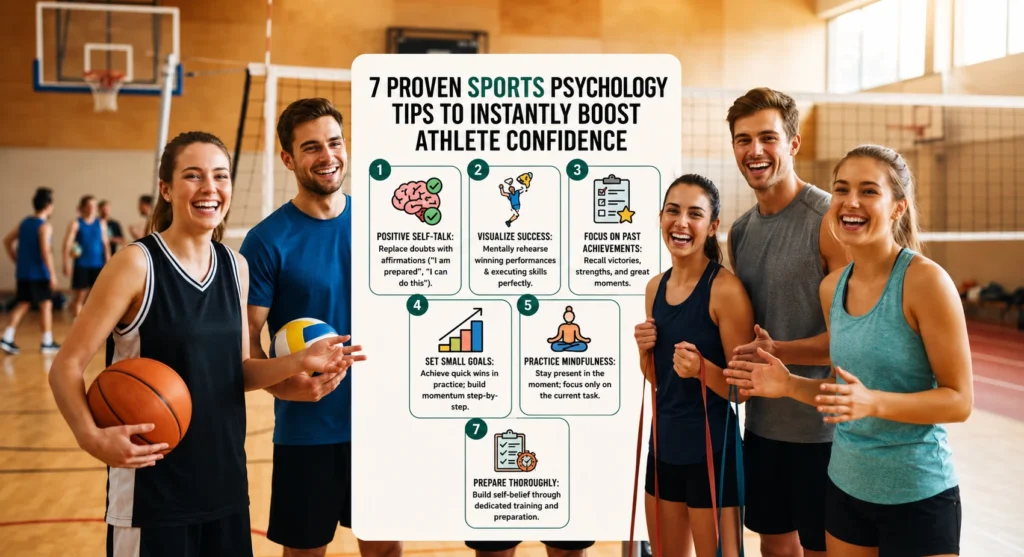

1. Sports Psychology Tip: Positive Self-Talk to Boost Athlete Confidence

Your thoughts influence your performance more than you realize. Negative thinking creates hesitation, while positive cues improve focus.
Replace:
- “I might fail” → “Stay sharp and ready”
- “I’m not good enough” → “I’ve trained for this.”
Why it works:
Positive self-talk reinforces belief and reduces performance anxiety.
At-home application:
Repeat 2–3 confidence cues during workouts or drills.
2. Visualization to Boost Athlete Confidence
Visualization is one of the most effective mental training methods for athletes at home.
When you are getting ready to perform, think about what it will be like to do a job. Imagine yourself doing things like scoring a goal or winning a sprint or making a pass. This helps you get used to what it feels like to do, and it helps you feel less nervous.
Here is a simple thing you can do to get ready:
- Close your eyes for five minutes
- Think about what it will be like in a match
Think about yourself scoring a goal or winning a sprint or making a pass and imagine that you are doing it very well.
If you want inspiration, take a look at some of the world’s greatest athletes and how mindset played a key role in their success.
3. Goal Setting to Boost Athlete Confidence
Clear goals create direction and measurable progress.
Instead of:
- “I want to improve.”
Set:
- Complete 15 accurate passes
- Improve sprint start speed
- Maintain focus for full sessions
Why it matters:
Small wins build confidence consistently.
4. Pre-Game Routine to Boost Athlete Confidence
Consistency creates control. A structured routine prepares your mind for performance.
Common routines include:
- Dynamic warm-ups
- Music for focus
- Breathing exercises
- Reviewing key actions
Athletes across the USA, UK, and Europe rely on routines to enter peak mental states.
5. Pressure Training to Boost Athlete Confidence
Confidence grows when you handle pressure effectively.
Train under pressure at home:
- Add time limits to drills
- Compete against personal bests
- Introduce consequences for mistakes
This improves your sports performance mindset and prepares you for real-game intensity.
6. Strength Focus to Boost Athlete Confidence
Many athletes lose confidence by focusing only on weaknesses.
Instead:
- Identify your strengths
- Train them consistently
- Use them during competition
Example:
A fast winger should emphasize sprinting and attacking plays to reinforce confidence.
7. Reset Technique to Boost Athlete Confidence
Mistakes are part of sport. What matters is how quickly you recover.
Simple reset method:
- Take a deep breath
- Use a trigger word (“next”)
- Refocus immediately
This technique is widely used in sports mental toughness training.
8. How to Apply Sports Psychology Tips to Boost Athlete Confidence Daily
To get results do these things every day:
- Spend 5 to 10 minutes on visualization. Talking to yourself.
- Do pressure drills 3 or 4 times a week.
- In each session, set goals for yourself.
- Before you train, do your routine.
Doing these things over. It turns mental training into a habit.
Learning to reset after mistakes is essential, especially when nerves start to take over before or during a match. If you often feel anxious before competitions, it’s worth exploring practical strategies to manage that pressure.
FAQs:

1. What are the best sports psychology tips to boost athlete confidence?
The best sports psychology tips to boost athlete confidence are things like talking to yourself in a positive way, picturing yourself doing well, setting goals for yourself, and training to handle pressure. These sports psychology tips really help athletes feel more confident and do better when they compete. Sports psychology tips like these can make a difference in how athletes perform.
2. How can I build confidence as an athlete at home?
I can build confidence as an athlete at home by using things like visualization and structured routines and doing confidence drills without any equipment. Building confidence as an athlete at home is about doing things over and over. Consistency is really the key to building confidence as an athlete.
3. Do sports psychology tips really improve performance?
Yes. Mental training improves focus, reduces anxiety, and enhances decision-making during competition.
4. How long does it take to see results?
Most athletes notice improvements within a few weeks when practicing regularly.
5. What are confidence drills for athletes?
Confidence drills include pressure-based exercises, repetition of strengths, and goal-focused training sessions.
6. Can beginners use these sports psychology tips?
Absolutely. These techniques are simple and effective for all levels, including youth athletes.
7. How do athletes stay confident after failure?
They use reset techniques, focus on the next action, and avoid dwelling on mistakes.
Start Using Sports Psychology Tips to Boost Athlete Confidence Today
Confidence is not something you are born with. It is something you can learn. You can build confidence by doing things over and by training your mind.
By using these tips from sports psychology to help athletes feel more confident, you will be able to:
- Improve how consistent you are
- Deal with pressure
- Do your work
If you start using one or two of these techniques today and you keep doing them, your confidence in yourself will get stronger over time. Confidence will grow naturally over time if you do this.
Visit here for more mental health tips: 1. NHS – Mental Wellbeing Guide


