

Football GPS Metrics Explained 2026: The Ultimate Way to Improve Performance

Learn football GPS metrics explained simply. Understand player load, sprint data, and how GPS tracking improves performance and prevents injuries.
Football GPS Metrics Explained: Why They Matter
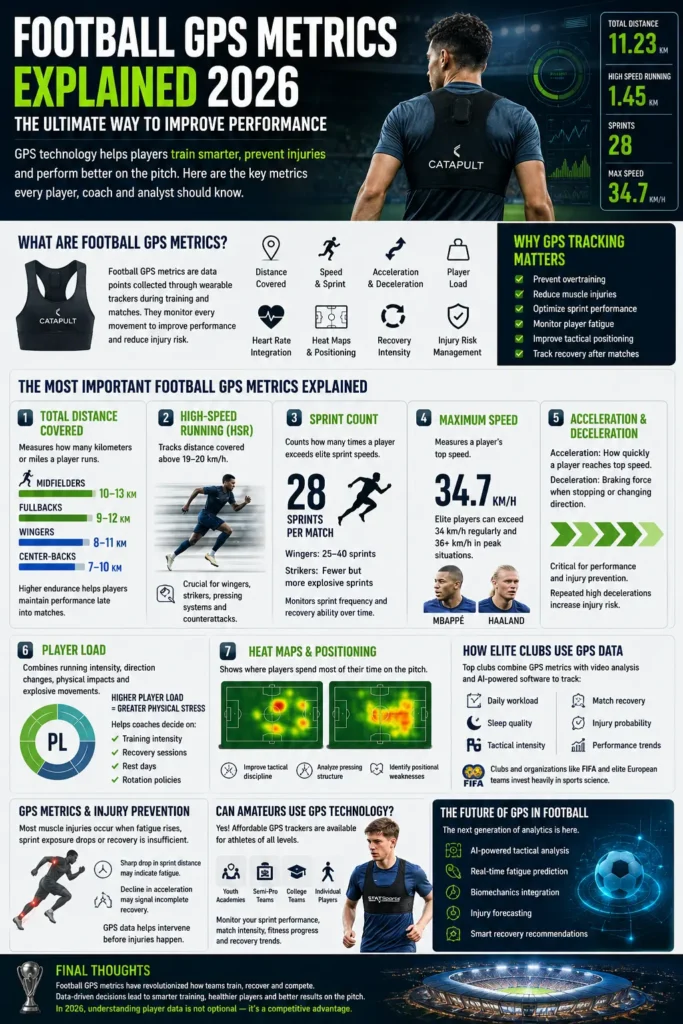
Football is in the age of data. Coaches no longer rely on observation they rely on performance that can be measured.
If you’ve ever wondered what those numbers mean when players wear tracking vests, this guide breaks down football GPS metrics explained in a way that actually makes sense.
What’s more, you’ll learn how those numbers translate into real improvements on the pitch better fitness, fewer injuries.
You can also read Best GPS Trackers for Football Players: Ultimate Guide for 2026
What Are Football GPS Metrics?
Football GPS metrics are data points collected from wearable tracking devices worn by players during training and matches.
These devices are:
- Satellite GPS Tracking
- Accelerometers
- Gyroscopes
- Heart rate watches
They give a full picture of player movement, intensity and workload.
The difference between teams that collect data and teams that actually improve performance is understanding football GPS metrics correctly explained.
Football GPS Metrics Explained: The Core Data Points

Let’s break down the most important metrics every coach and player should understand.
Total Distance Covered
This is a measure of how much a player is running in a match or training session.
- Midfielders often run 10-13 km
- Defenders and forwards generally run less
But distance is not the only measurement.
High-Speed Running Distance
This is a measure of how much distance a player can cover at a given speed, usually 19.8 km/hour.
Why it’s important:
- Indicates intensity of match
- Attacking and defensive effort shown
More high-speed distance players tend to be more involved in decisive moments.
Sprint Distance
The sprint distance is defined as explosive efforts above 25 km/h.
This is important for:
- Wingers
- Strikers
- Fullbacks
In modern football it’s often a case of short sprints.
Acceleration and Deceleration
This is one of the most important sections in football GPS metrics explained.
Acceleration = how quickly a player can get faster Deceleration = how fast they are speeding up
Why it’s important:
- Injury risk increases with high deceleration loading
- Frequent accelerations reflect high physical demand
Football is not straight line running, it is stop-start movement all the time.
Player Load™
Player load is an aggregate measure of total physical stress.
It features:
- Power of movement
- Changes of Direction
- Forces of impact
It’s like a “total workload score” for a player.
When player load increases too quickly, injury risk increases. It has been medically proven.
Football GPS Metrics Explained for Training Use
Understanding data is one thing — using it is where teams gain an advantage.
Individual Training Adjustment
Not all players should train the same way.
With GPS data, coaches can:
- Reduce load for fatigued players
- Increase intensity for underperforming players
- Customize sessions based on match output
This prevents overtraining and improves consistency.
Position-Specific Conditioning
Football GPS metrics explained properly show that every position has different demands.
Examples:
- Wingers → high sprint distance
- Midfielders → high total distance
- Defenders → high deceleration loads
Training should reflect these differences instead of using a one-size-fits-all approach.
Fatigue Monitoring
GPS data can be used for early fatigue detection.
Signs of a problem include:
- Running at slower speed
- Reduced high-speed distance
- Prolonged recovery time
This enables coaches to:
- Player rotation
- Change strategy
- Avoid late-game performance drops
Football GPS Metrics Explained for Injury Prevention
One of the biggest advantages of GPS tracking is reducing injuries.
How injuries happen
Most soft-tissue injuries occur when workload increases too quickly.
How GPS helps
By tracking:
- Weekly load
- Sprint frequency
- Acceleration spikes
Coaches can identify risk early and adjust training.
Research published in the British Journal of Sports Medicine highlights the importance of workload monitoring in injury prevention.
Common Mistakes When Interpreting GPS Metrics
Mistakes are common even with good data.
Context amnesia
Statistics without context don’t tell the whole story.
Or a player that covers less distance is not underperforming they are tactically disciplined.
Depending too much on one metric
Distance or sprint speed, alone, could be misleading.
Performance is a combination of many metrics.
Data not answered
Data collection makes decision making possible.
What matters is to put the insights to consistent use.
Conclusion: Turn Data Into Performance
Understanding football GPS metrics explained is no longer optional it’s essential.
Teams that use GPS data effectively:
- Train smarter
- Stay fitter
- Reduce injuries
But the biggest advantage is not the technology itself. The regularity with which you use the data comes from.
Keep it simple Track KPIs. A few small tweaks.
That’s how you improve performance over time.
FAQ: Football GPS Metrics Explained
What are football GPS metrics?
Football GPS metrics are data points such as distance, sprint speed and player load gathered from wearable tracking devices to assess performance.
Why are GPS metrics important in football?
They help coaches make data-driven decisions to track workload, improve fitness and reduce the risk of injury.
What is player load in football?
Player load is a combined metric that measures total physical stress based on movement intensity and direction changes.
Are GPS trackers accurate in football?
Yes, modern systems are highly accurate and widely used by professional clubs and national teams.
Can amateur teams use GPS tracking?
Yes, many affordable GPS systems are available, making performance tracking accessible even for grassroots teams.