
I’ve covered sports across America for over 15 years, from press boxes and sidelines to Super Bowls in the rain. I’ve seen trends come and go, most of them as fast as they arrived.
But AI in sports 2026 is not the same.
This is not hype or a fad. Artificial intelligence is already changing the way games are played, coached and analyzed, from the locker room to the front office. If you’re not paying attention to AI in sports 2026, you’re missing the biggest transformation in sports since the rise of TV.
I have been on the front lines of this game and seen its human side. Now I’m going to break down what this shift is all about.
Let’s get to it.
Table of Contents
AI in Sports 2026 — How Artificial Intelligence Is Completely Transforming Every Game You Watch
AI in Sports 2026 — Why This Year Changes Everything
The numbers are the story. Artificial intelligence in sports is already a $1 billion market worldwide and is projected to hit $2.5 billion by 2030, growing at a rate of more than 16 percent per year.
That’s not a lot of hype. That infrastructure.
AI in sports 2026 is everywhere. From youth academies to top leagues. A teen competing for a scholarship. Pros like LeBron James preparing for the playoffs. All are using AI-powered tools to track performance, reduce injuries and gain an edge.
Still more potent is its power of invisibility. Fans don’t see it, but AI is influencing decisions in real time from sideline strategy to scouting and injury prevention.
And that unseen effect is changing the game
AI in Sports 2026 and Injury Prevention — The Game Changer Nobody Talks About Enough
How AI in Sports 2026 Predicts Injuries Before They Happen
This is where it really changes the game.
The conventional approach to sports medicine has been reactive, injuries happen, treatment ensues and the cycle continues. But AI in sports 2026 has turned that model on its head. It’s not about fixing damage anymore, it’s about predicting damage.
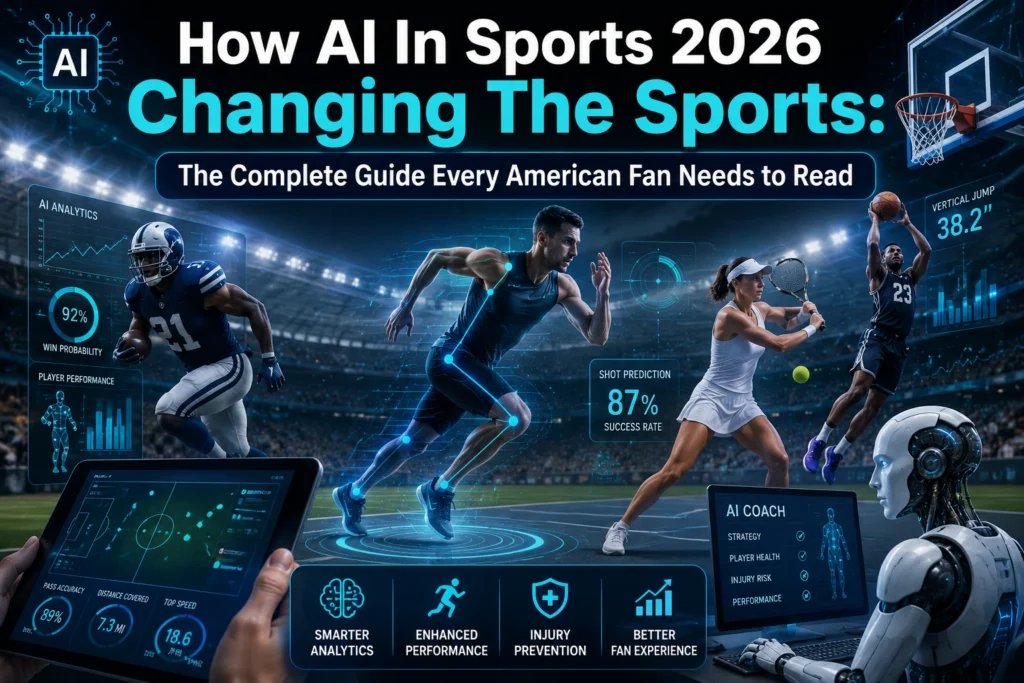
Companies such as Zone7 use machine learning to analyze training load, biometrics and injury history to identify risks before athletes feel anything. With accuracy greater than 90% some systems can predict soft tissue injuries up to a week in advance.
That is the real breakthrough. Players may feel good but the data says otherwise and that’s where AI in sports 2026 becomes so useful.
Research has shown that AI-enabled injury systems can reduce re-injury rates by over 20%. For teams investing millions in players, keeping them healthy isn’t just medical, it’s financial and competitive.
Leagues like the NFL are already ahead of the game using digital athlete models to track biomechanics and spot risks early. Catapult’s tools track movement, speed and fatigue in real time, feeding AI systems that warn coaches before injuries happen.
This is no longer a future. It’s already changing how athletes stay on the field.
My take: This is the AI in sports use that I care about the most. Not because it is the most exciting. But because it protects human beings. These are real people with real bodies, real families, and real futures beyond football. Anything that keeps them healthier and extends their careers is worth celebrating.
AI in Sports 2026 Performance Analytics — Turning Data Into Decisions
AI in Sports 2026 and Real-Time Coaching Intelligence
Imagine you are the offensive coordinator of an NFL team. Fourth quarter. Two minutes. Your quarterback is Patrick Mahomes in the pocket on third and five against a zone defense. You have about eleven seconds to make the right move.
The 2026 NFL sideline Microsoft Surface tablets are not just screens showing footage. They’re running AI systems built on Microsoft Copilot that automatically filter and surface the most relevant plays from that game—based on live variables like down, distance, and defensive formation—without the coach having to search manually. The system delivers the right information to the coach at the right time. It is not a choice. But it makes the decision-maker much better.
That distinction is very important to me. AI does not substitute the coach. It hones the coach. The emotional intelligence, the read of the room, the halftime speech that turns a game around — none of that comes from a machine. But the data behind the decision? That can absolutely be processed better by AI than by any human being.
The NBA has gone deep on this. The league partnered with Amazon Web Services to build a system that transforms billions of digital data points collected during games into actionable insights delivered directly to the NBA fan app. Motion-tracking cameras powered by computer vision analyse every player movement on the court — shot efficiency, defensive positioning, spacing tendencies, transition speed. Coaches can now see things that previously required dozens of hours of manual film study. AI compresses that process into minutes.
AI in Sports 2026 Scouting and Player Development — Finding the Next Superstar
How AI in Sports 2026 Is Rebuilding the Scouting Industry
In the old days, scouting was all about gut feel and the strength of your network. You played games. You watched film. You rang. You believed your eyes and your experience.
That method produced great scouts, and it produced big blind spots. Those players from less visible markets never got seen. Cultural and geographic biases shaped who was assessed and who was ignored. Every single year, good players from little countries, little schools and little markets fell through the cracks.
That’s where AI comes in. Today, autonomous scouting systems are capable of analyzing player performance across thousands of measurable variables at once – biomechanics, game footage, movement patterns, fitness data and even patterns derived from social media and fan sentiment. Instead of each scout watching one game in one city, an AI system can process footage from hundreds of leagues in dozens of countries and surface a ranked list of prospects based on objective performance metrics.
In June 2025, RII Sports Technology, a company, launched two new platforms for football coaches, Scout AI and Graphite AI, to help teams at all levels of competition. Now, AI is a standard tool for trade simulations and draft evaluations in front offices of major American leagues. The result is a more transparent, more accurate and more globally inclusive pipeline for athletic talent discovery.
AI in Sports 2026 Refereeing and Officiating — Getting the Call Right Every Time
AI in Sports 2026 and the End of Referee Controversy
Fans get upset about bad calls. They always have. Offside not awarded in a World Cup game. Terrible strike zone call in a playoff game. A foul that was no foul. Championship decided. These are moments that have caused arguments and broken hearts for generations.
Those moments are rare with AI officiating. And in some sports they have already wiped them out completely.
The clearest is professional tennis. By 2025, every out-of-bounds call on the ATP Tour will be made by Hawk-Eye, the automated electronic line-calling system powered by computer vision and AI. These courts no longer have human line judges. It is faster. It’s more correct. It all adds up. No arguing, no mistake, no dispute:
FIFA’s Semi-Automated Offside Technology (SAOT) has revolutionized the most controversial decision in the game. Now, it takes an average of 70 seconds to review an offside call. The current process, aided by AI, is more accurate than any review that would be done by a human and takes about twenty-three seconds. SAOT was present at Euro 2024, the FIFA Women’s World Cup 2023 and the FIFA Club World Cup 2025.
It’s a small detail and it still amazes me.” FIFA President Gianni Infantino announced in January 2026 that every player at the 2026 World Cup in America will be digitally scanned to create a personalised AI avatar. These avatars will be used to help make tracking players in games more accurate. The tournament kicks off in a few weeks on June 11. Here in American soil we’re about to witness the most technologically advanced World Cup ever.
EuroLeague to allow wearables on players during games from 2025 Kinexon’s chest wearable now offers live vitals and performance metrics in real official competition. Other leagues in Europe are expected to do so in 2026. The boundary between the training environment and the competition environment is getting blurred.
AI in Sports 2026 Fan Experience — Watching Games Has Never Been This Personal
AI in Sports 2026 Is Personalising How You Watch Every Match
For much of broadcast history, every fan watching a game saw the same thing. The director selected the camera angle. The commentator decided what to say. The network picked which stats to show. You sat there and ate it.
That time is past.
Sports broadcasts will fragment into personalized feeds by 2026, based on individual viewer preferences. The casual fan watching Sunday Night Football gets the traditional coverage. A data-obsessed fan watching the same game sees real-time statistical overlays, snap counts and personnel package information at the same time. New viewers who don’t know the sport get simplified explanations and contextual help. Same game. Totally different experiences. All done in the background by AI.
ESPN and other major broadcasters have been developing AI commentary systems that produce natural-sounding, contextually appropriate descriptions of live action. Older versions were robotic and badly timed. By late 2025 the technology had evolved to the point where the commentary was truly natural, a mix of AI base description, expert analysis pre-recorded and dropped in at just the right moments.
The Cleveland Cavaliers are using AI agents to send personalised emails to fans – altering the content, the tone, the colour scheme and even the emoji use based on that individual fan’s particular behaviour and preferences. The San Antonio Spurs have incorporated similar tools into their operations. These aren’t mass marketing campaigns. They are one-to-one, personalized messages, but they’re being sent to tens of thousands of people at once.
In 2025, the NBA and English Premier League partnered with Microsoft to launch a Premier League Companion, a digital tool driven by Microsoft Copilot and Azure OpenAI that provides fans with a deeper, smarter, more interactive way to follow their teams.
AI in Sports 2026 Market Size and Future Outlook — Where Is This All Going?
The AI in sports market today is about a billion dollars worldwide. It’s expected to reach two and a half billion by 2030. And that growth is being fueled by three forces that aren’t slowing down anytime soon.
Firstly, the amount of data available in sport is increasing every year. Wearables, cameras, sensors, biometric monitors, social media – each source provides AI systems with more data to process and learn from.
Second, there is constant pressure to find any edge available because of the competition between teams and leagues. If you’re not using AI to identify injury risks, evaluate talent and personalise fan communications when your competitor is, you fall behind. We all want to be left behind.
Third, the technology is advancing quickly. Systems that seemed impressive a year ago feel dated now. The speed at which machine learning and computer vision are advancing is breathtaking.
MLB is expected to implement fully automated strike zones in regular-season games for the 2026-27 season. Top football leagues to rollout AI in real-time VAR decisions AR glasses will start appearing in stadiums, giving fans live data overlays during games. Virtual season tickets for custom AI VR experiences are now available for purchase.
My honest opinion: The only thing I keep reminding myself and the people I write for is that AI is a tool. It is not a substitute for the human drama which is the heart of sport. The return. The blow. The rookie no one believed in. Veteran playing with pain in his last match. There are moments machines can’t create. It can only be good for the people involved to get better and recover faster. That’s what it does. And it’s remarkable in that role.
AI in Sports 2026 — Challenges and Things We Still Need to Figure Out
Progress always has its problems. I must name them, for honesty requires it.
Privacy of data is a concern. Today athletes are monitored in such physical and biological detail that it raises serious questions about ownership, consent and what happens to that data when it leaves the field of play. A player’s biometric profile contains sensitive health data. Who owns it ? Who can use it? There are no yet satisfactory answers to these questions.
These systems are very expensive. Sports in developing countries, youth programs and small teams can’t afford the same AI infrastructure as the NBA or Premier League clubs. The gap threatens to create a two-tier system in which the rich franchises get richer and the rest fall further behind.
AI lacks emotional intelligence as well. It can’t read a locker room. It can’t pick up the momentum swing in a match. It cannot deliver the halftime talk that changes twenty-two people’s minds about themselves. The human coach, the veteran scout, the trusted medical professional — they’re not going anywhere. They work better with AI. It doesn’t replace them.
AI in Sports 2026 FAQ — Answers to the Questions Every American Sports Fan Is Asking
What does AI actually do in professional sports right now?
In 2026, AI is being used extensively in professional sports for injury prediction, real-time performance analytics, personalized fan experiences, player scouting and evaluation, referee decision support, broadcast personalisation, and operational management in arenas and front offices. It is embedded at every level of the industry from youth academies to elite leagues.
How does AI predict sports injuries before they happen?
AI injury prediction systems collect data from wearable sensors, GPS trackers, historic injury records and biometric monitors. They take it all in at once, looking for patterns that signal a higher risk of injury, patterns the human eye can’t see. Platforms like Zone7 promise to predict soft-tissue injuries up to a week before they occur with more than ninety percent accuracy.
Is AI being used at the 2026 FIFA World Cup?
Yes. A lot of. In January 2026, FIFA announced that all players at the 2026 World Cup will be digitally scanned to create a personalised AI avatar to improve tracking precision during matches. FIFA’s Semi-Automated Offside Technology is also in use throughout the tournament to reduce review times and improve accuracy on offside decisions.
Which American sports leagues are using AI the most?
The NFL, NBA, and MLB are among the most advanced users of AI in American professional sport. The NFL uses AI-powered sideline tools and the Digital Athlete program for injury modeling. The NBA partnered with Amazon Web Services for performance analytics and fan engagement. Multiple teams across these leagues use AI for scouting, trade analysis, and personalized marketing.
Will AI ever replace human coaches and referees?
Not in any full sense, and not anytime soon. AI offers data, analysis, pattern recognition and decision support. It doesn’t possess the emotional intelligence, contextual judgment or leadership skills of great human coaches and officials.” The best model is collaboration – AI does the data processing at scale, but it is human professionals who make the final decisions and add the human element sport demands.
How is AI changing the fan experience in 2026?
AI is also personalizing the fan experience like never before. Broadcasts are fragmenting into personalized feeds according to viewer preference. Teams are now talking to individual fans in a personalised way based on their behaviour. AI-built apps deliver real-time custom stats, highlights and content. The one-size-fits-all passive spectator experience is being replaced by something more genuinely interactive and personal.
What is the AI in sports market worth in 2026?
The global market for AI in sports was worth around $1 billion in 2024 and is growing at over 16% per year. It is projected to rise to $2.5 billion by 2030, as adoption expands across more leagues, sports and countries.
Can smaller teams and youth programmes access AI sports technology?
Access is improving, but not equally. High-end AI systems used by elite professional franchises are out of the financial reach of smaller organisations. But in youth academies, cheaper AI-driven training apps are starting to emerge, and the price of the technology should drop as the market matures and competition between providers increases.
Final Word — AI in Sports 2026 Is the Story of Our Generation
In fifteen years of sports journalism I have covered a lot of stories. Championships. Scandals. Retirements. Comebacks. Each one felt important in its time.
But the story of AI in sports in 2026 feels different. It feels like it’s permanent.
This is not a tool that’s going to have its moment and then disappear. This is infrastructure . This is the new foundation being built right now, piece by piece, game by game, season by season, for all of American sport – and global sport. It makes the athletes healthier. This makes the decisions smarter. And that makes the fans more connected.” This means the games themselves are fairer.
And we are still in the first chapters.
The World Cup begins in America on June 11. 48 countries on American soil, all players digitally scanned, all movements tracked in real time by AI. That is the world we live in today.
I would not trade it for anything. And I can’t wait to keep telling you how it all turns out.