
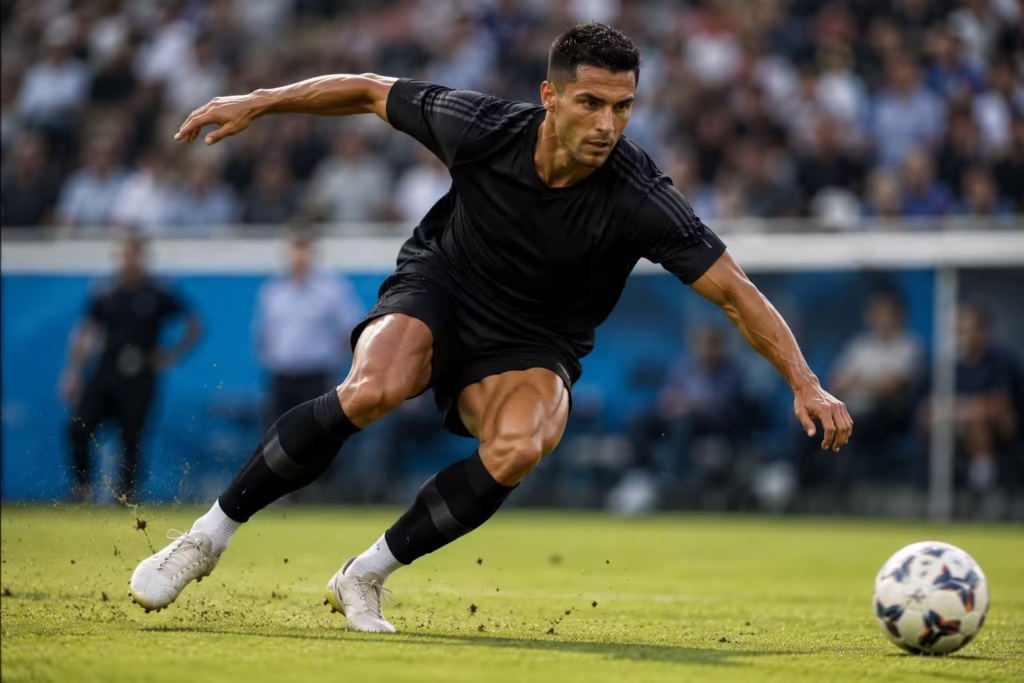


If you’ve ever hobbled down a staircase two days after a pickup match, you already know the answer isn’t just “your legs.” It’s specific muscles, in a specific order, for specific reasons — and understanding what muscles does a soccer ball sculpt is the difference between training smarter and just quietly suffering every Monday.
Soccer builds one of the most complete lower-body-dominant physiques in sport, with real contribution from the core and even the upper body. But it also produces some of the most brutal delayed soreness of any recreational activity, because so much of the sport runs on eccentric contraction — the “braking” phase of muscle work that causes the most microscopic damage. Below is the full breakdown, backed by peer-reviewed research, plus why the soreness hits as hard as it does and how to actually recover from it.
Table of Contents
What Muscles Does a Soccer Ball Sculpt? (Full Breakdown by Body Region)
Soccer is often described as a leg sport, but that undersells it. The ball itself doesn’t do the sculpting — the repeated actions around it (sprinting, cutting, kicking, jumping, and stabilizing) do. Here’s what muscles a soccer ball sculpts, region by region.
Lower Body Muscles Soccer Sculpts
Building stronger muscles takes more than simply playing matches every week. Targeted strength work improves power, stability, and resilience, helping you perform better while lowering your injury risk. If you’re looking for a practical routine, explore our guide on Powerful Strength Training for Soccer Players at Home 2026: Build Explosive Power Fast.
This is where most of the work happens, and where most of the visible muscle development shows up:
- Quadriceps — powers kicking, sprinting, and jumping; heavily loaded during deceleration and cutting.
- Hamstrings — control leg speed during the kicking motion and absorb force while sprinting; one of the most commonly strained muscle groups in the sport.
- Glutes — drive explosive acceleration, hip stability, and change of direction.
- Adductors (inner thigh/groin) — control lateral movement and are loaded heavily during cutting and tackling, making them a frequent strain site.
- Calves (gastrocnemius and soleus) — absorb impact on every stride and push-off; research on running mechanics has found the ankle and calf complex works even harder, relative to load, than the knee extensors.
- Hip flexors (iliopsoas) — lift the leg for kicking and sprinting starts.
Understanding what muscles a soccer ball sculpts is only the first step. For players training outside organized sessions, How to Build Explosive Leg Power for Football at Home 2026 explores practical exercises that target the same muscle groups discussed here.
Core and Upper Body Muscles Soccer Sculpts (Often Overlooked)
Because field players can’t use their hands, most people assume the upper body does nothing. In reality:
- Abdominals and obliques — stabilize the trunk during kicking, heading, and quick directional changes, and help transfer force from the legs.
- Lower back (erector spinae) — supports posture through 90 minutes of running and absorbs load during headers and shoulder-to-shoulder contact.
- Shoulders and arms — used for balance, shielding the ball, and throw-ins, and contribute to overall stability during contact.
This full-body demand is part of why soccer is frequently cited as one of the more complete conditioning sports — it isn’t just cardio, and it isn’t just legs. Once you understand what muscles soccer develops, it’s easier to see why hamstring injuries are so common. Improving sprint mechanics and eccentric strength together can reduce strain while helping you reach higher top speeds. Learn how in How to Increase Sprint Speed in Football at Home 2026 Without Costly Mistakes.
Why Do the Muscles Soccer Sculpts Get So Sore? (The Real Science of DOMS)
The soreness you feel 24 to 48 hours after a match has a name: Delayed Onset Muscle Soreness (DOMS). It’s not lactic acid buildup — that’s a persistent myth. It’s caused by microscopic muscle damage from eccentric contraction, and soccer is unusually good at producing it.
Eccentric Contraction: The Real Reason for Post-Match Soreness
A muscle contracts two different ways: concentrically (shortening, like the upward part of a squat) and eccentrically (lengthening under load, like controlling your descent). Eccentric contractions are consistently linked to greater muscle damage and more severe soreness than concentric ones, and physiology researchers note this happens partly because eccentric work recruits fewer motor units to handle the same force, concentrating tension over a smaller area of muscle tissue.
Soccer is full of eccentric-heavy movements:
- Decelerating out of a sprint
- Cutting and changing direction
- Landing from a header or jump
- Absorbing a tackle
- The braking phase after a kick’s follow-through
A 2025 study on collegiate female soccer athletes found that whole-body decelerations were directly predictive of future soreness — essentially confirming in a real match setting what lab studies had already shown about eccentric load and DOMS.
What’s Actually Happening Inside the Muscle
DOMS is generally classified as a mild, type 1 muscle strain. Physiology research describes a pain-free window of roughly 12 to 24 hours after exercise, with soreness typically peaking between 24 and 72 hours later — which lines up closely with why the second day after a match, not the first, tends to be the worst. The damage triggers a short-term inflammatory response and a temporary drop in strength and range of motion, which is why heavily-used muscles can feel weak, not just sore.
Which Muscles Get Sorest After a Soccer Match?
Not every muscle soccer sculpts gets equally sore. Based on injury and load research in match-play soccer, here’s roughly how it breaks down:
| Muscle Group | Soreness Severity | Why |
|---|---|---|
| Quadriceps | Very high | Constant deceleration and cutting load |
| Hamstrings | Very high | High-velocity eccentric loading while sprinting |
| Calves (soleus/gastrocnemius) | High | Near-constant loading on every stride, frequently under-trained |
| Adductors/groin | High | Repeated lateral load, common strain site |
| Glutes | Moderate | Explosive but shorter-duration loading |
| Core/lower back | Moderate | Continuous stabilization, lower peak force |
| Shoulders/upper back | Low | Mostly stabilizing role, minimal direct load |
How Wearable Tech and GPS Data Reveal Which Muscles Soccer Sculpts
This is where a lot of existing “muscles soccer works” content stops short — it’s written like it’s 2015, with no mention of how modern tracking tools confirm the picture.
GPS vests and accelerometers used in training now track deceleration counts, high-speed running distance, and total load per session — not just distance covered. Since research links decelerations specifically to future soreness, this data lets coaches see which players are accumulating the eccentric load that leads to sore or strained hamstrings, quads, and calves, before it becomes an actual injury. Heart rate monitoring adds another layer, showing whether a player’s cardiovascular effort matches their muscular workload, which helps separate general fatigue from localized muscle overload.
For an everyday player without access to a sports science department, the practical takeaway is simpler: the number of hard stops and direction changes in a session matters more for next-day soreness than total distance run.
How to Recover Faster from Soccer Muscle Soreness (Evidence-Based Tips)
None of these eliminate DOMS entirely — that’s not realistic — but they can meaningfully reduce severity and speed up recovery:
- Don’t fully rest. Light active movement (easy cycling, walking) the day after a match promotes blood flow to sore muscles without adding further eccentric damage.
- Prioritize sleep. Most muscle repair happens during deep sleep, and inadequate recovery time tends to compound soreness across a heavy training week.
- Use contrast or cold exposure selectively. Research comparing heat and cold treatments for DOMS shows mixed but generally modest benefits — useful, but not a substitute for proper load management.
- Fuel protein intake in the hours after playing. Muscle repair requires amino acids; under-fueling extends the soreness window.
- Track deceleration load, not just distance, if you have access to a GPS vest or running watch. Since decelerations are a strong predictor of soreness, a spike in hard stops during training is a more useful early warning sign than mileage alone.
- Strengthen the eccentric phase directly. Exercises like Nordic hamstring curls and slow-tempo squats train muscles to tolerate eccentric load better over time, which several strength and conditioning programs use specifically to reduce hamstring and quad strain risk.
FAQ: What Muscles Does a Soccer Ball Sculpt?
Does soccer work your abs? Yes. The abdominals and obliques stabilize the trunk during kicking, heading, and sudden direction changes, and help transfer force generated by the legs, though they aren’t loaded as heavily as the quads or hamstrings.
Why are my legs so sore two days after playing soccer, not the next day? This is classic Delayed Onset Muscle Soreness. Research shows there’s typically a pain-free period for the first 12 to 24 hours, with soreness peaking between 24 and 72 hours, which is why the second day after a match is often worse than the first.
What muscle is most overlooked in soccer training? The calf and ankle complex. Research comparing joint effort during running has found the ankle plantar flexors work harder, relative to load, than the knee extensors, yet most amateur training programs focus almost entirely on quads and hamstrings.
Can GPS trackers show which muscles are getting overworked? Not directly, but they can flag load patterns, especially deceleration counts, that research has linked to future soreness and strain risk, which lets players and coaches intervene before a niggle becomes an injury.
Today’s football players have access to technology that was once reserved for professional clubs. GPS trackers can measure sprint distance, accelerations, decelerations, and overall workload, giving you a clearer picture of your performance. If you’re considering one, check out Best GPS Trackers for Football Players: Ultimate Guide for 2026.


