
That Sunday morning in Austin still stays with me.
Cool breeze. Empty streets. Shoes hitting pavement in rhythm. I finished my run feeling strong. But then I checked my stats.
My watch said 5 miles. My app said 5.6.
Same run. Same effort. Different numbers.
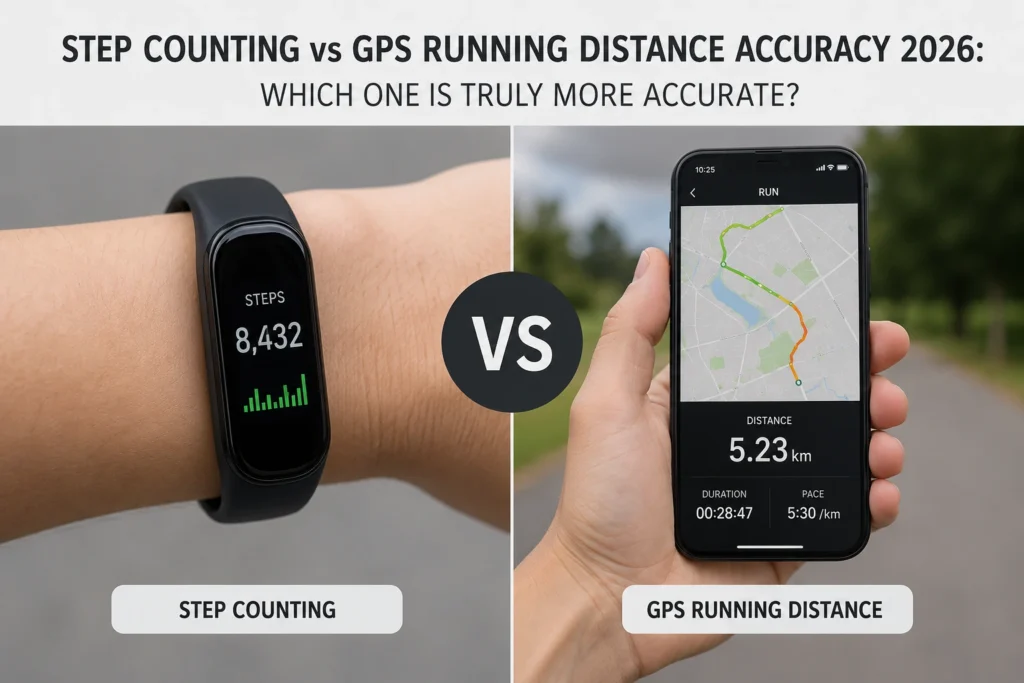
That’s when I started digging deeper into step counting vs GPS running distance accuracy, a topic every runner should understand.
If you run, this matters. A lot.
If you want to know more about Best GPS Trackers for Football Players: Ultimate Guide for 2026
Why Step Counting vs GPS Running Distance Accuracy Matters
Tracking your distance is not just about numbers. It shapes your training, your goals, and your confidence.
If your data is wrong:
- Your pace calculations suffer
- Your progress becomes unclear
- Your race preparation gets risky
That’s why understanding step counting vs GPS running distance accuracy is essential for beginners and experienced runners alike.
What Is Step Counting in Step Counting vs GPS Running Distance Accuracy?
Step counting is one of the oldest and most reliable tracking methods in fitness.
It works quietly in the background.
How Step Counting Works
- Uses motion sensors (accelerometer)
- Counts every step you take
- Multiplies steps by stride length
Benefits of Step Counting for Running Distance Accuracy
- Works indoors (treadmills, gyms)
- Saves battery life
- Provides stable, consistent tracking
But here’s the reality.
Your stride is not fixed.
It changes with:
- Fatigue
- Speed
- Terrain
- Weather
That’s where step counting vs GPS running distance accuracy starts to show differences.
What Is GPS in Step Counting vs GPS Running Distance Accuracy?
GPS changed running forever.
It doesn’t guess. It tracks.
How GPS Running Distance Tracking Works
- Connects to satellites
- Tracks your exact position
- Maps your running route in real time
Benefits of GPS for Running Distance Accuracy
- Tracks real distance precisely
- Adjusts for pace automatically
- Shows route, splits, and elevation
But GPS isn’t flawless.
Signal issues happen.
And when they do, accuracy drops.
Step Counting vs GPS Running Distance Accuracy: Key Comparison

Let’s break down step counting vs GPS running distance accuracy in real-world situations.
Step Counting vs GPS Running Distance Accuracy Outdoors
Winner: GPS
In open areas like parks or suburban roads, GPS dominates.
It tracks your actual movement, not estimates.
Step counting relies on assumptions.
Step Counting vs GPS Running Distance Accuracy Indoors
Winner: Step Counting
GPS doesn’t work indoors.
On treadmills, step counting is your only option.
Step Counting vs GPS Running Distance Accuracy Over Long Runs
Winner: GPS (Mostly)
For long distances:
- GPS gives better real-world accuracy
- Step counting may drift slowly
But if GPS signal drops (cities, tunnels), errors appear.
Step Counting vs GPS Running Distance Accuracy for Battery Life
Winner: Step Counting
GPS drains battery fast.
Step counting barely uses power.
For marathon runners, this matters.
Please visit here for: Football GPS Metrics Explained 2026: The Ultimate Way to Improve Performance
My Personal Experience with Step Counting vs GPS Running Distance Accuracy
I’ve been running for years.
Early mornings. Trail runs. Races across different states.
And here’s my honest opinion on step counting vs GPS running distance accuracy:
- GPS is more accurate most of the time
- Step counting is more reliable in tough conditions
I use both.
GPS for distance.
Steps for consistency.
That balance works best.
When Step Counting Wins in Step Counting vs GPS Running Distance Accuracy
Yes, step counting can win.
1. Urban Running
Tall buildings distort GPS signals.
Step counting stays stable.
2. Trail Running
Dense forests weaken GPS.
Steps don’t care.
3. Long Battery Runs
When battery matters, step counting is safer.
When GPS Wins in Step Counting vs GPS Running Distance Accuracy
1. Route Mapping
Only GPS shows where you ran.
2. Pace Tracking
GPS provides real-time pace updates.
3. Race Conditions
For races, GPS is more dependable.
What Experts Say About Step Counting vs GPS Running Distance Accuracy
From coaches to sports scientists, the consensus is clear:
- GPS is preferred for outdoor accuracy
- Step counting is valuable for controlled environments
Professional runners often combine both.
Devices today use hybrid tracking systems.
That’s not a coincidence.
It’s the most accurate approach.
The Human Side of Step Counting vs GPS Running Distance Accuracy
I once met an older runner in Colorado.
No watch. No tracker.
Just miles of experience.
He said, “I don’t measure distance. I measure effort.”
That stuck with me.
Because beyond step counting vs GPS running distance accuracy, running is still human.
Data helps.
But it doesn’t define your run.
You can also read: How AI in Sports 2026 Is Revolutionizing the Game: The Ultimate Guide Every American Fan Must Read
Best Solution for Step Counting vs GPS Running Distance Accuracy
If you want the best results:
Choose devices that:
- Combine GPS and step tracking
- Offer stride calibration
- Use advanced multi-band GPS
This hybrid approach gives the highest accuracy.
Final Verdict on Step Counting vs GPS Running Distance Accuracy
Let’s make it simple.
- Best outdoor accuracy → GPS
- Best indoor accuracy → Step counting
- Best overall solution → Combination of both
If you had to pick one?
Go with GPS.
But don’t ignore step data.
It tells a deeper story about your movement.
Visit here for
FAQs About Step Counting vs GPS Running Distance Accuracy
1. What is more accurate when it comes to tracking my runs: step counting or GPS running distance accuracy?
I think GPS is generally more accurate when I am running outside, while step counting is better when I am running on a treadmill or indoors.
2. I have noticed that sometimes my GPS and step counting show different distances, so I was wondering why this happens?
It seems that GPS tracks my location, which is really cool, while step counting just estimates the distance based on how long my stride is.
3. Can I do something to improve the accuracy of my step counting?
Yes, I can calibrate my stride by running a distance that I know, and that will help my step counting be more accurate.
4. I was also wondering if the weather affects how accurate my GPS running distance is?
Yes, it does, because clouds and buildings and trees can all interfere with the GPS signals, which makes sense.
5. Is step counting something that I can rely on when I am training for a marathon?
It is helpful for making sure I run consistently. If I need to know the exact distance I have run then GPS is still better.
6. Should I care about step counting versus GPS running distance accuracy if I am just starting out with running?
Yes, I think it is a good idea to understand how both of these work so I can train smarter from the very beginning and get the most out of my runs.
Polar Global Fitness Technology — Advanced heart rate and GPS systems
Final Thoughts
At the end of the day, step counting vs GPS running distance accuracy is not about choosing sides.
It’s about understanding tools.
Use them wisely.
Trust your data but also trust your body.
Because the real win isn’t perfect tracking.
It’s finishing the run.