
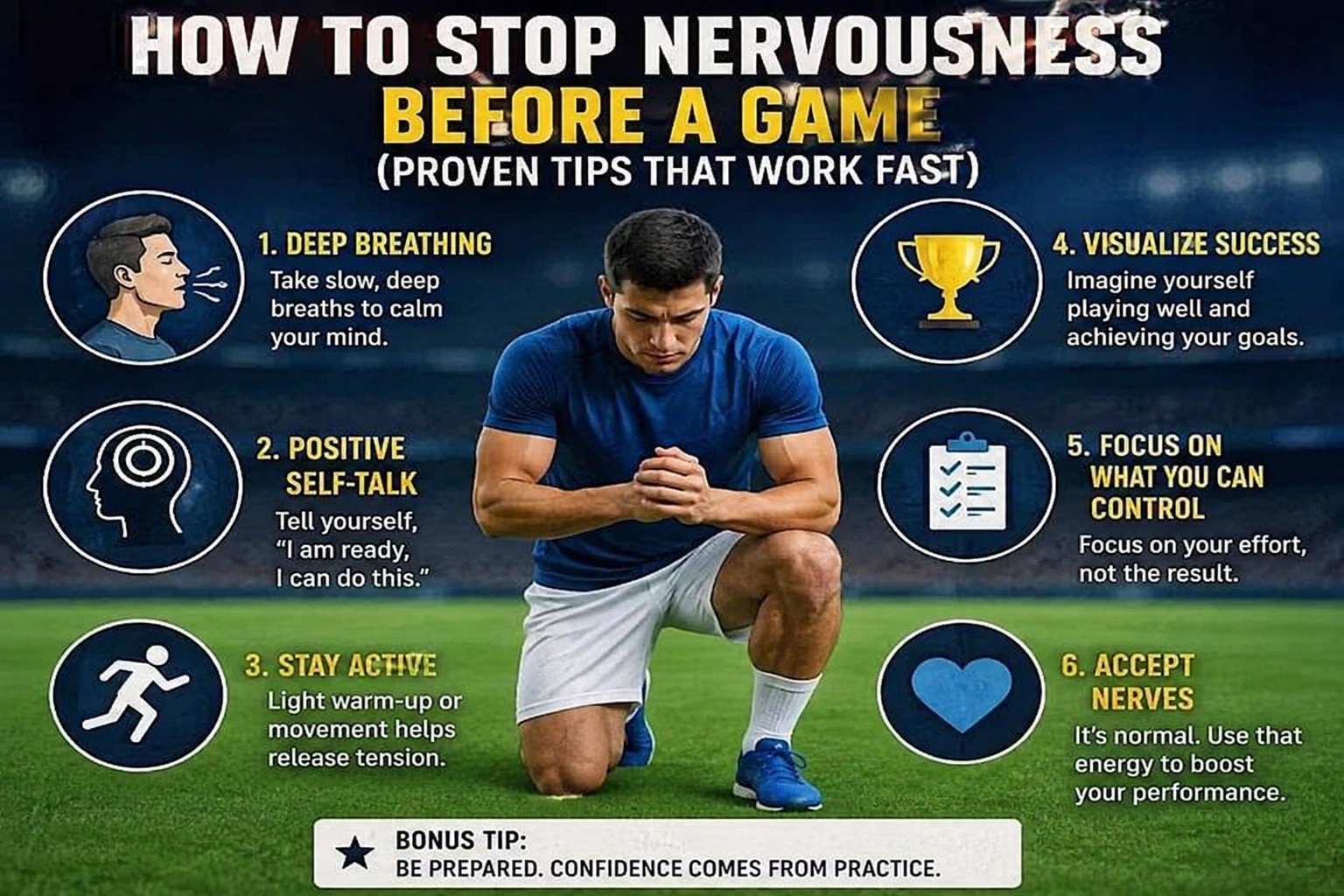

This guide breaks down exactly how to stop nervousness before a game using techniques that are grounded in sports psychology, practical to apply in the changing room, and fast enough to work in the 30 minutes before kick-off.
Every athlete has been on the sidelines before a big game with the heart pounding, palms sweating, mind racing. That tight, restless feeling is the pre-game jitters, and it happens to everyone at some point, from Sunday league players to Premier League professionals.
Here’s where most sports guides go wrong: nervousness isn’t a weakness. It’s your body stocking up energy, sharpening your senses, getting you ready to perform. The real problem is not the nervousness but not knowing what to do with it when it arrives.
How to Stop Nervousness Before a Game: Start With the Science

Before jumping into techniques how to stop nervousness before a game, it helps to understand what is actually happening when nerves hit.
Sports psychologists call it the Yerkes-Dodson principle – performance gets better with increased arousal, but only up to a point. Too little nervous energy and you play flat. Too much, and the anxiety kicks in. Hesitation. Bad decisions. Physical tension.
We don’t want to get rid of your nerves. It’s to keep them in the productive zone where your body stays alert but your mind stays clear.
When you understand this, the whole approach to managing pre-game nerves changes. You stop trying to “calm down” and start trying to channel up.
Why Athletes Feel Nervous Before a Game
The Fear of Judgment
One of the most common drivers of pre-game anxiety is the awareness of being watched. Teammates, coaches, family, and fans all create invisible pressure. The brain interprets that social exposure as a threat, triggering the same stress response as a physical danger. Now I am sharing the exact reason why athletes feel nervous
Overemphasis on Outcome
When a player gets too caught up in the results winning, not messing up, showing what they’re made of—the mind is yanked out of the game and into a loop of what-ifs. It is that drifting in the mind that most hurts performance.
Unfamiliar Environments
Playing in a new stadium, against an unknown opponent, or in a high-stakes cup match forces the brain into threat-detection mode. The more unfamiliar the situation, the louder the anxiety.
Gaps in Preparation
Nerves are often honest. If training has been inconsistent or physical condition feels off, the body registers that gap and signals it as worry. The fix, in that case, starts long before match day.
How to Stop Nervousness Before a Game – 10 Techniques That Actually Work
1. Regulate Your Breathing Before Your Mind Spirals
Anxiety first hijacks breath. Rapid shallow breathing increases the stress response and increases the feeling of nerves. When you slow your exhale you are literally telling your nervous system to stand down.
Try this pattern on in the fitting room:
- Inhale through your nose slowly for 4 counts
- Hold lightly for 2 counts
- Exhale through your mouth for 6 to 8 counts
2. Reframe Nerves as Readiness
This technique, known as anxiety reappraisal, has strong backing in sports psychology research. Instead of telling yourself “I’m nervous,” try telling yourself “I’m ready.”
The physical sensations are the same, heart pounding, heightened awareness and energy in the chest. The only difference is the name you call them. That feeling of fear turned into excitement instead of threat, consistently beats the attempt to suppress it.
3. Use a Focused Pre-Game Warm-Up Routine
Routines work because they give the brain something familiar to anchor to in unfamiliar conditions. A consistent physical and mental warm-up sequence acts as a signal that everything is under control.
A practical match-day routine might look like:
- 10 minutes of progressive movement (light jog into dynamic stretching)
- 5 minutes of ball work or sport-specific drills
- 2 minutes of breathing exercise
- 60 seconds of positive self-cue statements
Over time, the routine itself becomes a trigger for focus. Your brain learns: when this sequence happens, it is time to compete — not time to worry.
4. Narrow Your Focus to the First Five Minutes
Much of the pre-game anxiety is forward-looking athletes fear the entire 90 minutes before a ball is even kicked. A good solution is to reduce your mental horizon to just the first five minutes.
What do you do in the first minutes of the match? Where do you need to go? What will your first touch likely be? Vague dread becomes concrete preparation as you walk through a short, specific mental preview.
5. Practise Mental Imagery the Right Way
Most athletes have heard of visualisation but few have used it properly. Specificity and sensory detail are the trick.
Do not just imagine playing well in a general sense. Imagine the texture of the pitch underfoot, the sound of the crowd, the weight of the ball on your boot. Walk through specific scenarios a 50/50 challenge, a set piece, a counter-attack and see yourself responding decisively and calmly.
Done consistently in training and before matches, this kind of mental rehearsal builds genuine neural pathways that make composed performance feel familiar rather than foreign.
6. Talk to yourself the way you would talk to a teammate
Athletes are usually much harder on themselves than they would ever be on a teammate who’s struggling with confidence. When the inner voice starts to project failure, cut it off.
Write down two or three short trigger phrases that have meaning for you personally – not generic affirmations, but words that connect to your actual game. Examples:
- “First touch, then decide”
- “Stay on your toes”
- “I’ve trained for this”
Repeat them during warm-up. The specificity matters. Generic positivity slides off the mind under pressure; personalized cues stick.
7. Release Muscle Tension Intentionally
Athletes do not know physical tension builds up before games. Tight shoulders, tight jaw, tight hip flexors. These are all anxiety stored in the body that suck energy and restrict movement.
Progressive muscle relaxation is easy. Tighten each muscle group for five seconds, then release it completely. Start from your feet and go upwards. The rapid alternation of tension with release soon eases overall muscular tightness and helps you feel physically prepared rather than defensive.
8. Control What You Can, Let Go of What You Cannot
But a huge part of pre-game anxiety is trying to control in your head things that are truly beyond any one player’s control – referee decisions, the weather, how the opposition plays, whether teammates perform.
Before the game, make a short mental list: What can I influence today? Your location. Your work. Your message * Your attitude when you fail. Turning mental energy to those things replaces anxiety with agency.
9. Use Cold Water or Physical Reset Signals
If nerves are running particularly high and your mind is locked in a spiral, a cold water splash on the face or wrists can break the cycle physically. The stimulus briefly activates the dive reflex, slowing heart rate and interrupting the anxious thought loop.
Some players use a physical anchor gesture squeezing a fist and releasing it as a deliberate signal to reset attention. The specific action matters less than the consistency; over time, the gesture becomes linked to the mental reset itself.
10. Build Match Exposure Over Time
Ultimately, the most durable cure for pre-game nervousness is experience. The brain habituates to repeated exposure every match you play trains your nervous system to treat that environment as normal rather than threatening.
If competitive game time is limited, replicate high-pressure conditions in training. Small-sided games with consequences, penalty shootouts, timed drills with teammates watching these all help reduce the novelty response that drives anxiety on match day.
A Simple Pre-Match Routine to Pull It All Together
Here is a match-day sequence that incorporates the key techniques above:
| Time Before Kick-Off | Action |
| 60 minutes | Hydrate, light stretching, set your mental cue phrases |
| 40 minutes | Progressive warm-up, dynamic movement |
| 20 minutes | Breathing exercise (4-2-6 pattern, 2 minutes) |
| 10 minutes | Mental imagery — run through your first five minutes of play |
| 5 minutes | Cue phrases, physical reset gesture, ready stance |
Common Mistakes That Make Pre-Game Nerves Worse
- Trying to eliminate nerves completely — this creates a second layer of anxiety about feeling anxious
- Arriving without a plan — unstructured waiting time before a game is where nerves thrive
- Comparing your internal state to other players — most athletes hide their nerves well; the calm you see in teammates is often performance
- Skipping physical preparation — tired muscles and poor warm-up make mental anxiety significantly harder to manage
- Negative post-mistake self-talk — one error early in a game should not define the next 80 minutes
Conclusion
Learning how to stop nervousness before a game is not about eliminating the feeling — it is about redirecting it. Pre-game nerves are not a sign that something is wrong with you. They are a sign that your body and mind recognise the importance of what you are about to do.
Through the consistent application of breathing regulation, focused routines, mental imagery, and intelligent self-talk, nervous energy becomes a competitive asset rather than a liability. The most reliably successful athletes under pressure are not usually the calmest – they are the athletes that have mastered working with what their body gives them.
Start with two or three of the techniques in this guide. Include them in your match day preparation. One day you will learn to love your nerves before a game, not just tame them.
FAQ Schema
Q: How to stop nervousness before a game quickly?
A: The quickest method is controlled breathing – inhale for 4 counts, hold for 2, exhale for 6-8. Within minutes this activates the parasympathetic nervous system, lowering heart rate and mental tension ahead of kick-off.
Q: Is it normal to feel very nervous before a football match?
A: Absolutely normal. Nerves before games get athletes at all levels, including professionals. The key difference is that experienced players have learned to interpret that feeling as readiness rather than a threat.
Q: What causes nervousness before a sports game?
A: The biggest ones are fear of being judged, outcome-based thinking, unfamiliar environments and lack of physical preparation. Knowing which one applies to you helps you apply the right management technique.
Q: Do breathing exercises actually help with game nerves?
Q: Yeah. When you breathe out longer than you breathe in, you stimulate the vagus nerve which directly slows your heart rate and reduces the physiological symptoms of anxiety. It makes athletes feel quantifiably calmer within two minutes of practicing it.Q: How long does it take to overcome pre-game nerves?
A: Most athletes improve significantly within four to six weeks of consistently practicing mental and physical practice skills. Full habituation increases over time with match experience.


