
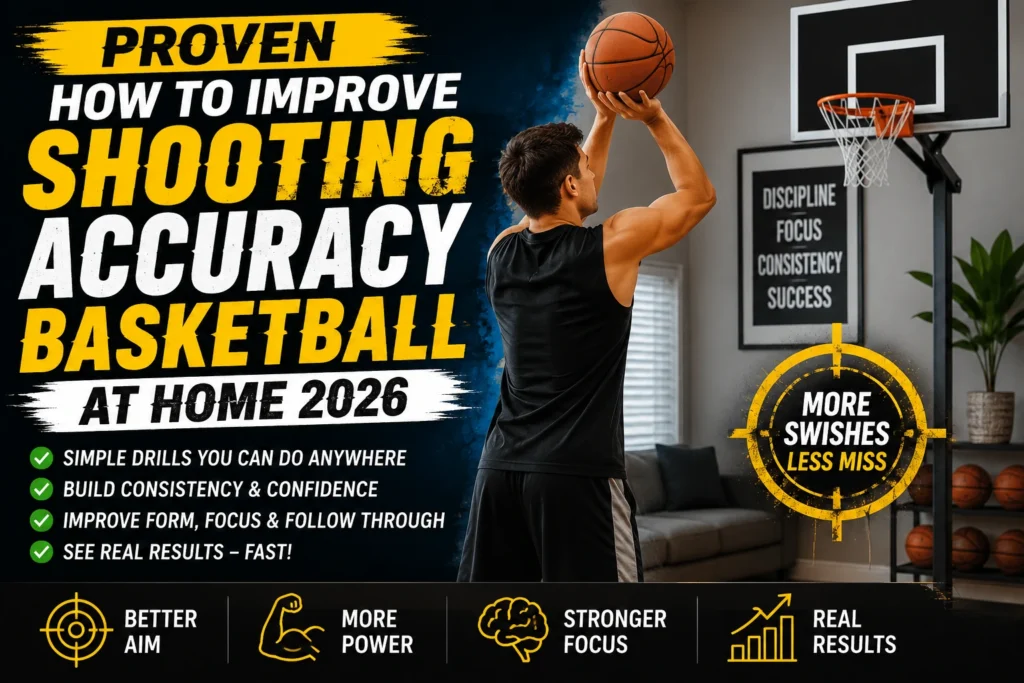

Learn how to improve shooting accuracy basketball at home with proven drills, form fixes, and a 20-minute daily routine that actually works.Picture this: it’s 9 p.m., the driveway hoop is lit by a single porch light, and you’ve just bricked your tenth three in a row. Sound familiar? Every player — from a 13-year-old in Manchester practicing on a park court to a college walk-on in Ohio grinding in an empty gym — hits this wall. The good news is that fixing it doesn’t require a personal trainer, a fancy gym, or even a full-size court.
This guide breaks down exactly how to improve shooting accuracy basketball at home, using the same mechanical principles coaches teach at the elite level, scaled down to whatever space you’ve got — a driveway, a garage hoop, or even just a bedroom wall and a tennis ball.
By the end, you’ll have a repeatable, science-backed system you can run in 20–30 minutes a day, no team practice required.
Table of Contents
Why Most Home Shooters Plateau (And It’s Not Talent)
Here’s the uncomfortable truth: most players who struggle with shooting accuracy don’t have a talent problem. They have a repetition-without-feedback problem.
Shooting hundreds of shots a week sounds productive, but if your elbow flares out on every attempt, you’re not building accuracy — you’re cementing a flaw. Research on motor learning consistently shows that quality of repetition, not volume alone, drives skill acquisition. This is why two players can both shoot 200 shots a day and end up with wildly different shooting percentages.
The fix starts with isolating the mechanics before adding pressure, distance, or game speed.
You can also read: LeBron James Player Development: The Incredible Journey from Talent to Scientific Mastery
The Core Mechanics Behind How To Improve Shooting Accuracy Basketball at Home
Before any drill will help, your base mechanics need to be sound. These five checkpoints form the foundation of every reliable jump shot, whether you’re shooting in an NBA arena or a backyard in Texas.
1. Foot and Base Alignment for Shooting Accuracy Basketball at Home
Your shooting-side foot should be slightly ahead of the other, both pointed toward the basket. A narrow, square base reduces side-to-side sway, which is one of the most common causes of shots drifting left or right.
2. The One-Motion Release Drill
When the catch, dip and release become one fluid motion instead of three separate stops, you’ll see a huge improvement in your catch-and-shoot accuracy. Practice this rhythm at home even without a hoop to build muscle memory that transfers directly to game shooting.
3. Elbow Alignment for a More Accurate Basketball Shot
The most correctable mistake in amateur shooting is the classic “elbow flare.” Your shooting elbow should be about under the ball, not to the side. A quick home test: Shoot facing a mirror or film yourself on a phone propped up on a wall.
4. Follow-Through and Wrist Snap at Home
A relaxed wrist snap with fingers pointing toward the rim (the “gooseneck” follow-through) adds the backspin that helps shots roll in rather than rattle out.
5. Consistent Release Point for Better Shooting Accuracy
At 5 feet from the basket or 23 feet from the basket, the ball should leave your hand at the same point relative to your forehead. Long and short misses caused by inconsistent release height.
How to Improve Shooting Accuracy Basketball at Home: The 20-Minute Daily Routine
This is the part that most guides don’t tell you about – a routine you can actually follow. Whether you’re shooting hoops in a suburban New Jersey driveway, a converted UK garage or a local community court, this routine fits your space.
Warm-Up Phase for How to improve Shooting Accuracy Basketball at Home (5 minutes)
- Form shooting from 3 feet — 20 reps focusing purely on follow-through, no power needed.
- Wall mirror reps — 15 reps of shooting motion (no ball or a soft tennis ball) to groove the one-motion release.
Form-Building Phase to Sharpen Basketball Shooting Accuracy (10 minutes)
- One-hand form shots — 15 reps per hand position from close range, isolating elbow alignment.
- Spot shooting ladder — Move back in 2-foot increments (3ft, 5ft, 7ft, 9ft), 10 makes required before advancing.
- Off-the-dribble reps — 10 shots after one dribble, training the catch-dip-release rhythm under slight motion.
Pressure Phase: Testing Shooting Accuracy Under Fatigue (5 minutes)
- Make-it-take-it from three spots — Shoot until you hit 5 makes from each spot; this builds focus under mild fatigue, which mimics late-game conditions.
- Free throw finisher — End every session with 10 free throws to reinforce a calm, repeatable routine under “tired” conditions.
This structure mirrors the same volume-to-feedback ratio coaches use in college and pro pre-season camps, just compressed for home space and equipment.
No-Hoop Drills: Improving Shooting Accuracy at Home Without a Basketball
Not everyone has access to a hoop how to improve shooting accuracy at home, every day — apartment living in London, winter weather in the Midwest, or simply a small backyard. These drills still build accuracy with zero basket required.
- Wall tap drill: Stand 2 feet from a wall, shoot the ball softly into it focusing only on wrist snap and follow-through.
- Mirror form check: Shoot in slow motion in front of a mirror, checking elbow and base alignment frame by frame.
- Tennis ball release drill: A tennis ball forces correct finger placement since it’s harder to “palm” incorrectly — great for fixing grip issues.
- Balance hold drill: Shoot your form and hold the follow-through position for 3 full seconds. Wobbling reveals base and balance issues instantly.
Equipment That Helps You How Improve Shooting Accuracy at Home
You don’t need a home gym to improve your shot — just a few low-cost tools that meaningfully speed up progress:
- A shooting mat or smooth driveway surface — consistent footing matters more than people expect.
- A phone tripod—recording your shot from the side and from behind the basket is the single cheapest way to self-coach.
- A weighted or slightly underinflated ball—occasionally training with a heavier ball builds strength in the fingers and wrist, though this should supplement, not replace, regulation-ball reps.
- A rebounder net (if you have a hoop) — cuts down dead time chasing balls, which means more reps per session.
Tracking Progress as You Improve Shooting Accuracy at Home
If you’re training solo, you need a way to know whether you’re actually improving. Three simple methods work well:
- Percentage logging — Track makes/attempts from 3 fixed spots every session. A spreadsheet or even a notes app works fine.
- Video comparison — Film your form weekly from the same angle. Mechanical drift shows up clearly over 2–3 weeks.
- Fatigue-point accuracy — Note your shooting percentage in the last 5 minutes of a session versus the first 5. A big drop-off signals a conditioning gap, not a mechanical one — something cross-training (sprint work, leg power drills) can help close.
Common Mistakes That Quietly Wreck Basketball Shooting Accuracy at Home
- Shooting too far, too soon. Players often skip form shooting and go straight to three-point range, reinforcing bad habits at distance.
- Chasing makes instead of form. A lucky make with poor mechanics teaches your brain the wrong lesson.
- Skipping fatigue training. Game shots happen tired; home practice that’s always fresh doesn’t transfer fully.
- No feedback loop. Without video or a mirror, the same flaw repeats invisibly for months.
Conclusion: Your Next Step to Better Shooting Accuracy Starts Tonight
Learning how to improve shooting accuracy basketball at home isn’t about finding extra hours — it’s about replacing unstructured repetition with a focused, feedback-driven routine. Start with the 20-minute daily plan, film yourself weekly, and resist the urge to chase makes over mechanics in the early weeks.
Actionable takeaways:
- Run the 20-minute routine at least 4–5 times per week for visible results within 3–4 weeks.
- Film your shot weekly — self-coaching only works with visual feedback.
- Fix mechanics close to the basket before extending range.
- Pair shooting work with conditioning so accuracy holds up late in games.
Frequently Asked Questions: How to improve shooting accuracy basketball at home
How long does it take to improve shooting accuracy basketball at home? Most players see measurable improvement within 3–4 weeks of consistent practice, provided sessions focus on form correction rather than just shot volume. Tracking percentage from fixed spots each week is the clearest way to confirm progress.
Can I get better at shooting without a hoop at home? Yep. Wall tap drills, mirror form checks and tennis ball release drills all develop shooting mechanics without requiring a basket, making them ideal for apartment living or bad weather days.
What’s the biggest mistake beginners make when practicing at home? Learning how to improve shooting accuracy basketball at homeToo far away shooting before mechanics are solid Start close to the basket and work your way out slowly before the bad habits take hold.
How many shots should I take per day to improve accuracy? Quality matters more than quantity. A focused 20–30 minute session with 100–150 purposeful reps typically beats 300+ unstructured shots, since fatigue and poor form override any volume benefit.
Does shooting with a weighted basketball actually help? It can help build wrist and finger strength when used occasionally, but it should supplement—not replace—practice with a regulation ball, since shooting feel needs to match game conditions.
Why do I shoot well at home but miss more in games? This usually points to a fatigue or pressure gap rather than a mechanical one. Adding fatigue-point shooting drills and conditioning work helps close that gap between practice and game performance.
Is it better to practice free throws or jump shots first? Learning how to improve shooting accuracy basketball at home Start with free throws or close-range form shots to lock in mechanics under low pressure, then progress to jump shots and game-speed reps once your base motion is consistent.
You can also visit here for more information about basketball


