
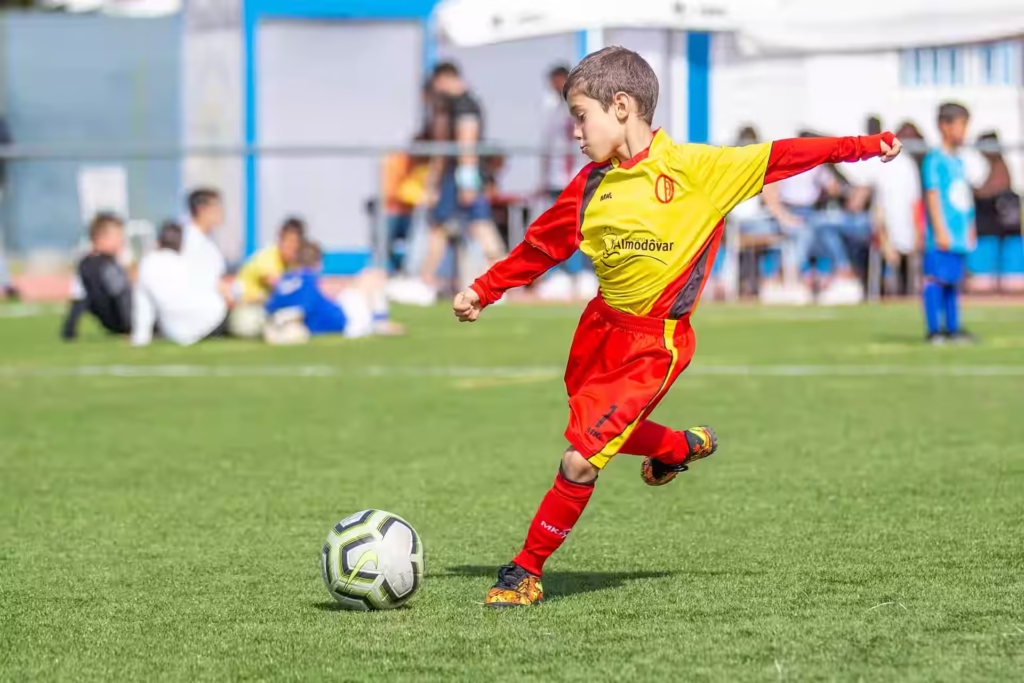

If you’re trying to figure out how to teach soccer to 5–10 year old kids, here’s something worth knowing before you set up a single cone: a 5-year-old and a 10-year-old are not the same athlete, and treating them like they are is one of the fastest ways to lose a kid’s interest in the game. A session built for a 6-year-old needs constant movement and almost no standing around. A session built for a 10-year-old can handle real tactical ideas. Mix the two up and you’ll either bore the older kids or overwhelm the younger ones, sometimes in the same practice.
This isn’t just a hunch. The Aspen Institute’s Project Play research found that the average child quits a sport by age 11, after less than three years, and the number one reason isn’t injury or cost. It’s that the sport simply stopped being fun. That single finding should shape almost everything about how you coach this age group, and it’s the thread running through this whole guide.
Most of what’s currently ranking for this topic treats “young kids” as one lump group and hands you a flat list of drills with no age logic behind it. That’s a real gap. Below, every drill and every coaching tip is tied to what a child can actually do at that age, based on the youth development framework U.S. Soccer itself uses across the country, not a generic “keep it fun” checklist recycled from blog to blog.
Table of Contents
Why Age-Appropriate Coaching Matters When You Teach Soccer to 5–10 Year Old Kids

U.S. Soccer’s Player Development Initiatives require 4v4 play with no goalkeeper for children under 9, and 7v7 for ages 9 and 10. This isn’t a loose suggestion from a coaching blog. It’s a governing-body standard, built from research into how kids actually develop physically and emotionally at these ages. The logic behind it is fairly simple once you see it: fewer players on a smaller field means each child touches the ball far more often, and touches on the ball are what build skill. Standing in a line waiting for a turn does not.
That framework tells you what to prioritize at each stage:
- Ages 5–8: Small-sided play, no goalkeeper, no offside rule, no heading
- Ages 9–10: A slightly larger 7v7 format, with a goalkeeper and offside now enforced
Coaching against this pattern, say, running full-field drills built for a competitive adult team with a group of 7-year-olds, works against how kids at this age actually absorb the game.
How to Teach Soccer to 5–10 Year Old Kids by Age Group

Ages 5–6: Building Comfort with the Ball
At this age, the goal isn’t tactics. It’s comfort. Most 5- and 6-year-olds are still developing basic coordination and balance, so almost every drill should involve their own ball, near-constant movement, and short, plain instructions.
- Keep sessions to 30–45 minutes total
- Use a size 3 ball
- Give every child their own ball whenever the drill allows it; sharing kills touches
- Use one-word or short-phrase cues (“stop,” “dribble,” “freeze”) instead of long explanations
- Expect attention to wander every 3–5 minutes, and plan short activity blocks around that reality rather than fighting it
Ages 7–8: Introducing Simple Decisions
By 7–8, kids can follow slightly more structured instructions and start making basic in-game decisions: pass or dribble, chase or hold position. This is the age to start layering in very simple choices without asking them to think like a tactician.
- Sessions can stretch to 45–60 minutes
- Introduce 1v1 and 2v2 situations
- Name positions loosely (attacker, defender) without locking kids into rigid formations
- Keep any explanation under 30 seconds; a quick demonstration teaches faster than a lecture at this age
Ages 9–10: Developing Real Game Understanding
At 9–10, kids are usually ready for the 7v7 format, understand basic spacing, and can start reading the game instead of just chasing the ball wherever it goes. This is where technical and tactical growth genuinely accelerates.
- Sessions can run 60–75 minutes
- Introduce possession concepts, like keeping the ball as a team rather than as individuals
- Start light tactical ideas: width, depth, and supporting whoever has the ball
- This is also a natural point to add dedicated technical work. Our guide on 7 soccer dribbling drills that actually help you beat defenders fits well once kids reach this stage
Easy Drills to Teach Soccer to 5–10 Year Old Kids
Each drill below is tagged with its ideal age range. Run three or four per session, mixing warm-up, skill work, and game-based activities so kids are rarely standing still for long.
1. Red Light, Green Light Dribbling (Ages 5–6)
Kids dribble freely inside a marked area. On “green light,” they dribble. On “red light,” they stop the ball dead under one foot. It’s a familiar childhood game with a soccer twist, and it quietly builds close control and listening skills at the same time.
- 5–8 minutes
- No equipment beyond a few cones to mark boundaries
2. Sharks and Minnows (Ages 5–7)
One or two “sharks” try to kick balls out of the grid while “minnows” dribble to protect their own and cross to the other side. This one teaches close control under light pressure, and in my experience it’s consistently one of the most requested games at this age.
- 8–10 minutes
- Rotate sharks every couple of minutes so everyone gets a turn
3. Toe Taps and Ball Freeze (Ages 5–6)
A simple ball-mastery station built around toe taps, sole rolls, and a “freeze” stop on the coach’s call. No decision-making required, which suits shorter attention spans well and gives kids an easy early win.
- 5 minutes
- Works well as a warm-up or a quick filler between higher-energy games
4. Partner Passing Gates (Ages 7–8)
Set up small cone gates and have partners pass the ball through them from a few yards apart. This builds accuracy and passing weight in a low-pressure, repeatable format that’s easy for kids to self-correct.
- 8–10 minutes
- Widen or narrow the gates to adjust the challenge
5. 1v1 to Mini Goals (Ages 7–9)
Two small goals, one attacker, one defender. On a signal, the attacker tries to score on either goal while the defender reacts in real time. This is a core teaching tool for both attacking confidence and basic defensive posture.
- 10 minutes
- Rotate pairs every two or three reps to keep energy up
6. Dribble Tag (Ages 6–8)
Everyone dribbles inside a grid, trying to kick other players’ balls out while protecting their own. It’s essentially soccer-flavored tag, and it teaches close control under pressure without kids realizing they’re “training” at all.
- 8 minutes
- The last player with a ball still inside the grid wins the round
7. Four-Goal Game (Ages 8–10)
Set up four small goals around the grid; either team can score on any of them. This forces constant scanning for open space, which is a meaningful step up from a single-goal game.
- 10–15 minutes
- Works well as a 3v3 or 4v4, matching the official small-sided model
8. Possession Square / Keep Away (Ages 9–10)
One team tries to keep possession inside a grid against a smaller defending team (say, 5v2 or 4v2). It’s the clearest bridge between individual skill and real tactical understanding, and it’s a scaled-down version of a drill you’ll see run at professional academies.
- 10 minutes
- Count consecutive passes to give the game a simple, motivating target
Coaching Tips for Teaching Soccer to Kids Ages 5–10
- Give every child a ball whenever the drill allows it. Shared balls mean fewer touches, and touches are what build skill over time.
- Keep verbal instructions under 30 seconds. Show the activity instead of explaining it at length. Young kids learn by doing, far more than by listening.
- Praise effort, not outcomes. “I love how hard you chased that ball” tends to build more lasting confidence than “great goal.”
- Plan more activities than you think you’ll need. A drill can flop for reasons that have nothing to do with your coaching. Having a backup ready means the session never stalls.
- Build in water breaks every 15–20 minutes, especially outdoors. The same hydration principles that matter for competitive tournament play matter here too; see our hydration strategy for multi-game soccer tournaments for the same idea applied at a higher level.
Common Mistakes Parents and Coaches Make Teaching Soccer to Kids
- Running adult-style practices. Long lines, long lectures, and static drills lose 5–10 year olds fast. This age group needs to keep moving.
- Overloading the schedule. More practice isn’t automatically better here. Our guide on how often you should train soccer covers age-appropriate training frequency, and our piece on recovering from overtraining in football explains why even young athletes need genuine rest between sessions.
- Skipping fundamentals in favor of “winning” drills. Pushing kids toward results before they’ve built basic ball comfort tends to backfire. Our guide on how to fix poor dribbling in soccer shows what happens later on when those early touches get skipped.
- Playing full-sized games too early. As covered above, U.S. Soccer’s own standards call for 4v4 through age 8 and 7v7 for ages 9–10, not full 11v11.
- Allowing heading before it’s appropriate. U.S. Soccer has prohibited heading for players under 11 since 2015, and more recent tracking found roughly a 25.6% drop in reported soccer-related concussions after the rule change took hold nationally.
If you’re outgrowing backyard sessions and thinking about a more structured environment, our guide to the best soccer camps in America is a solid next step once a child has the basics covered here down.
FAQ: How to Teach Soccer to 5–10 Year Old Kids

What age should kids start playing soccer?
Most children can start structured soccer activities around age 4 or 5, focusing purely on ball comfort and movement rather than competitive play. Formal small-sided leagues typically begin at U6, around ages 5–6.
How long should soccer practice be for 5–10 year olds?
Practice length should scale with age: roughly 30–45 minutes for ages 5–6, 45–60 minutes for ages 7–8, and 60–75 minutes for ages 9–10. Shorter, higher-energy sessions consistently work better at this age than longer, unfocused ones.
Should young kids play 11v11 soccer?
No. U.S. Soccer’s Player Development Initiatives call for 4v4 at ages 6–8 and 7v7 at ages 9–10, with 11v11 reserved for age 13 and up. Small-sided formats dramatically increase how often each child touches the ball, which drives faster skill development.
How many times a week should a young soccer player practice?
For most 5–10 year olds, one to two structured practices per week, plus informal, low-pressure play, is enough. More isn’t automatically better at this age. Burnout and boredom are bigger risks than undertraining, and they’re a big part of why the average child quits a sport by age 11.
Is heading the ball safe for kids under 10?
U.S. Soccer guidelines have prohibited heading in games and practices through age 11 since 2015, as a player safety measure, since children’s necks and brains are still developing during these years.


