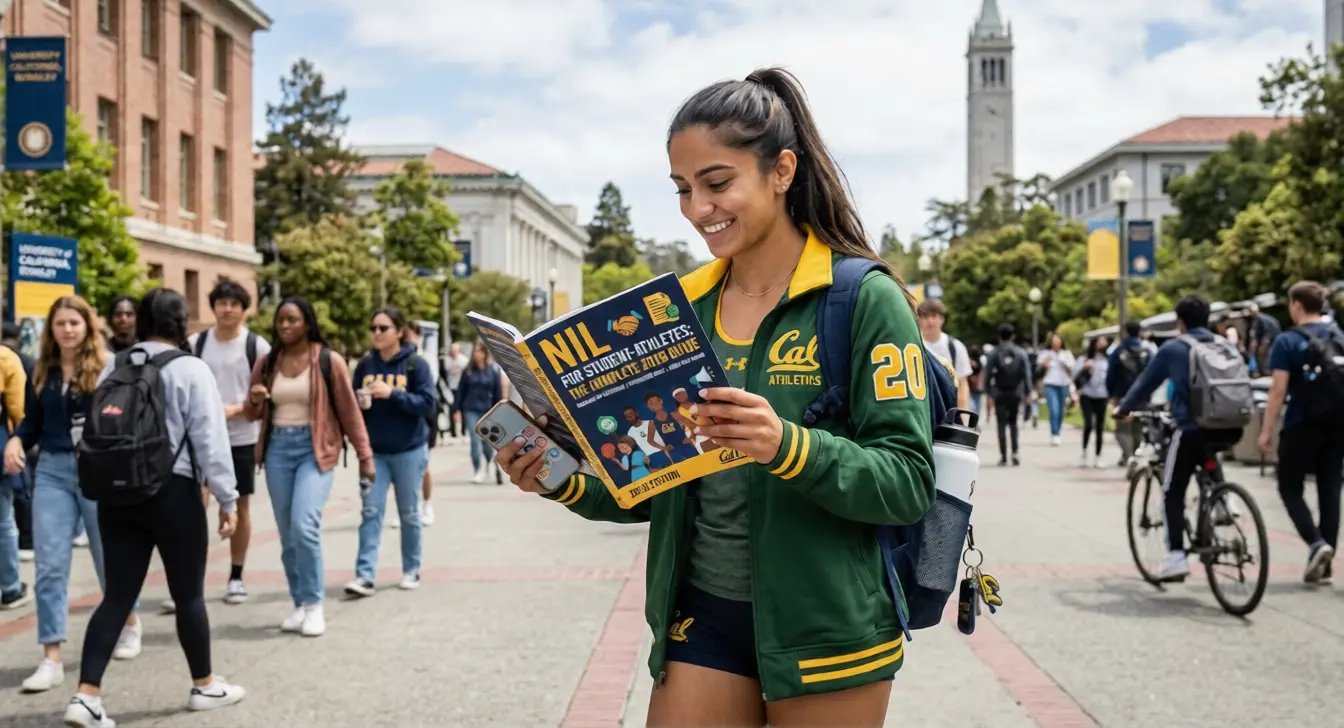

Three years ago a star running back could fill a stadium with sixty thousand seats on a Saturday.. The star running back would not get one dollar from all those people watching him play. Now things are different, for the star running. The star running back might get a lot of money from a sneaker company, maybe one hundred thousand dollars or more. The star running back also gets money from the school. Has someone to help him with his money before he is even old enough to rent a car. The star running back has a lot of opportunities to make money now. NIL for student-athletes isn’t a side conversation in college sports anymore it’s the conversation.
This guide is built from official NCAA and College Sports Commission rules, court filings, and current congressional bills, so you’re working from facts, not locker-room rumors.
If you are an athlete, a parent or a coach trying to figure out where the money comes from, in 2026 you are dealing with a system that has changed a lot in the eighteen months. This is a change than we saw in the previous seventy years.
This guide will tell you what Name Image and Likeness or NIL actually means today. It will also explain how NIL works with the National Collegiate Athletic Associations revenue-sharing model. You will learn which mistakes can get deals rejected and what is likely coming next for Name Image and Likeness. We will give you the information you need to know about Name Image and Likeness without using terms.
You can also read: Richest Athletes in America (2026 Update): Who Tops the List?
What Is NIL for Student-Athletes?
NIL for Student-Athletes stands for Name, Image, and Likeness. In plain terms, NIL for student-athletes is the right to earn money from your own personal brand — autographs, social media posts, sponsorships, camps, and appearances — without losing your college eligibility.
The House versus NCAA settlement, approved by a judge in June 2025 changed college sports a lot.
It created a $2.8 billion fund to pay athletes back.
In the past athletes were not allowed to get paid much.Most of the time they only got a scholarship.Even small endorsement deals could get them in trouble.For example Olympic skier Jeremy Bloom lost his college football eligibility at Colorado.He accepted sponsorships for skiing, which caused the problem.A series of court cases led to this change.The Supreme Court ruled in 2021 that the NCAAs pay limits were unfair.This was in the case of NCAA versus Alston.
The NCAA then let athletes earn money from their name, image and likeness.
This started on July 1 2021.
California had already passed a law about this in 2019. Other states followed, creating rules for athletes.These rules are still in place today. The House and NCAA settlement is a deal. It affects how college athletes get paid. The NCAA had rules before.Now athletes can earn money.
You can also read: Highest-Paid Athletes in America Right Now (2026)
NIL for Student-Athletes: Why It Took So Long
Universities long argued that paying athletes would destroy the “amateurism” model that funds scholarships and smaller sports programs. Courts disagreed, ruling that restricting athlete pay while billion-dollar television deals flowed to schools and conferences simply wasn’t fair. That tension between tradition and fairness still shapes every debate around NIL for student-athletes today.
NIL for Student-Athletes vs. Revenue Sharing: What’s the Difference?

NIL for Student Athletes The Complete 2026 Guide
Here’s where most people get confused. NIL for student-athletes is not the same thing as revenue sharing, even though both put money in athletes’ pockets. They run on two separate tracks with different rules, different payers, and different oversight.
| Feature | Third-Party NIL | Institutional Revenue Sharing |
| Who pays | Brands, businesses, boosters, collectives | The athlete’s own school |
| Legal basis | State laws + 2021 NCAA interim policy | House v. NCAA settlement (2025) |
| Earnings cap | No personal cap, but deals of $600+ must be reported | School-wide pool, ~$20.5M in 2025–26, rising to ~$21.3M in 2026–27 |
| Oversight body | College Sports Commission via NIL Go | College Sports Commission via CAPS |
| Typical use | Endorsements, social posts, appearances, camps | Direct payments similar to salary |
How the House Settlement Changed the Rules
The House versus NCAA settlement, which a federal judge approved in June 2025 changed college sports a lot.
It made a fund of $2.8 billion to pay back about 184,000 Division I athletes who played from 2016 onwards.For the time being, schools can now pay current athletes directly from their athletic money.
From July 1 2025 Division I schools that take part can share up to 22% of their sports money with athletes.This shared money is worth around $20.5 million per school in the year.The limit on shared money is expected to go up to $33 million by the middle of the 2030s as media deals keep growing.82% Of Division I programs chose the new system right away.It’s important to note that the new system of sharing revenue didn’t replace NIL for student-athletes.Instead it works alongside NIL.
Athletes can still make deals with brands. Now there are tighter rules.
You can also read: Amazing Ways How Athletes Make Money Outside Sports in USA 2026
How NIL for Student-Athletes Deals Actually Work
The $600 Rule and NIL Go
Any third-party NIL deal worth $600 or more must be reported through NIL Go, a clearinghouse run by the College Sports Commission, typically within five business days of signing. The CSC checks two things: whether the payer counts as an “associated entity” — a booster, collective, or major donor — and whether the deal reflects fair market value for real services performed.
What Gets a Deal Rejected
The CSC has gotten serious about enforcement. As of early 2026, it had cleared more than 17,000 deals worth over $127 million, while flagging and rejecting around 524 deals worth nearly $15 million for looking like disguised pay-to-play arrangements.
Common red flags that trigger a rejection include:
- Vague or “blanket” language, such as an athlete agreeing to “provide services as requested”
- No clear deliverable no set number of posts, appearances, or hours
- Payment amounts that don’t reasonably match the athlete’s market value or audience size
- Deals quietly routed through a school’s media-rights partner to dodge the reporting process
A Real-World Example
Picture a sophomore volleyball player at a mid-major school in Ohio. She isn’t on TV every week, but she has a loyal social media following built around training tips and game-day routines. A local sports nutrition brand offers her $1,200 to post three reels over a season. Because the deal clears $600, she submits it through NIL Go with a simple one-page contract listing the posts, dates, and payment.
Compare that to a football recruit who’s told a collective will pay him “for whatever the program needs” without naming a single task. That kind of language is exactly what gets flagged as a disguised recruiting inducement rather than genuine NIL compensation — and it’s the difference between a deal that sails through review and one that doesn’t.
NIL for Student-Athletes: USA, UK, and Europe
NIL is fundamentally an American concept, built around the NCAA’s unique model of college sports. The UK and most of Europe don’t have a direct equivalent, mainly because university sport there isn’t tied to the multi-billion-dollar media contracts that fund American football and basketball.
That said, the topic matters well beyond U.S. borders. Thousands of international student-athletes — tennis players, swimmers, track athletes, and footballers from the UK, Ireland, Germany, and elsewhere — compete on American college scholarships every year. For many of them, NIL income raises real visa complications, since F-1 student visas restrict off-campus work and self-employment. Anyone weighing a U.S. scholarship offer needs to understand these limits before signing, not after.
For UK and European readers simply following the story, here’s the simplest way to think about it: NIL for student-athletes is America’s way of letting amateur college players act like professionals, often years before they actually go pro.
Common Mistakes Student-Athletes Make With NIL
- Signing without a written contract that spells out the exact payment, deliverables, and deadlines
- Forgetting that NIL income is taxable — it’s typically self-employment income, often reported on a 1099, which can trigger quarterly estimated tax payments
- Assuming revenue-sharing money makes outside NIL deals unnecessary
- Working with collectives that use vague “pay for access” language instead of real, documented deliverables
- Skipping the school’s compliance office, which can usually flag problems before they become a violation
- Spending every check instead of setting aside money for taxes and the off-season
A Practical Roadmap for NIL for Student-Athletes
- Talk to compliance first. Run any deal worth $600 or more past your school’s compliance office before you sign.
- Get it in writing. Every deal should spell out payment, deliverables, deadlines, and usage rights.
- Track every dollar. A simple spreadsheet now saves a tax headache later.
- Build a brand, not a moment. Consistent posting and a clear personal story outperform one viral clip.
- Be skeptical of vague collective deals. If a deal doesn’t require real work, it likely won’t survive a CSC review.
- Bring in help early. A financial advisor, parent, or trusted mentor should be looped in once income becomes meaningful.
What’s Next for NIL for Student-Athletes?
The situation is still not clear. Federal rules about athlete pay are still being discussed in Congress. Nothing has been decided yet.
In 2026 a group of senators from both parties suggested a law called the Protect College Sports Act.
This law would help protect college athletes, limit the fees agents can charge to 5% and allow conferences to work together on media rights to increase the amount of money available.
Title IX issues are also being considered by the courts.
Some people think that the money from revenue sharing is not distributed fairly with too much going to football and men’s basketball.
The bigger question of whether college athletes should be considered employees is still not answered.
For now the best thing for any athlete to do is to assume that the rules will keep changing.
They should develop habits, such as signing contracts, checking compliance and planning taxes that will be helpful no matter what Congress or the courts decide next.
Conclusion: Your Next Move
NIL for student-athletes has moved from a legal gray area into a structured, if still evolving, financial system. It is really important to understand the difference between third-party deals and revenue sharing. You have to report anything that’s over six hundred dollars.. You should get real advice before you sign anything. This will keep you out of trouble and ahead of most of your peers.
Here are some quick things to remember:
- NIL and revenue sharing are two kinds of income. You should track both of them separately.
- If you make six hundred dollars or more you need to go through NIL Go and your compliance office.
- When it is tax time you should treat NIL income like it is self-employment income.
- Deals that are vague or say “pay for access” are the way to get into trouble.
- The rules are going to keep changing. You should build habits that will still work when the rules change again.
Frequently Asked Questions
What does NIL stand for in college sports? NIL stands for Name, Image, and Likeness. It refers to a college athlete’s legal right to earn money from endorsements, social media, appearances, and similar activities tied to their personal identity.
Is NIL for student-athletes the same as getting paid by a school? No. NIL deals come from outside businesses, brands, and boosters. Revenue sharing, created by the 2025 House v. NCAA settlement, is separate money paid directly by the athlete’s own school.
How much can a college athlete earn from NIL deals? There’s no personal cap on third-party NIL earnings. However, any single deal worth $600 or more must be reported through the NIL Go platform for a fair-market-value review.
Do high school athletes have NIL rights too? Sometimes. High school NIL rules vary widely by state and by state athletic association, with no single national rulebook. Families should check their state’s specific policy before signing anything.
Is NIL income taxable? Yes. NIL earnings are generally treated as self-employment income, often reported on a 1099 form, which can require quarterly estimated tax payments. A tax professional should review any meaningful NIL income.
What happens if a student-athlete doesn’t report an NIL deal? Unreported deals over $600 can be investigated by the College Sports Commission and may be disallowed if they look like disguised pay-for-play arrangements, putting the athlete’s eligibility at risk.
Can international student-athletes sign NIL deals in the U.S.? It depends on visa status. Many international athletes hold F-1 student visas, which restrict off-campus work and self-employment, so NIL income can raise immigration complications that need legal review.


