
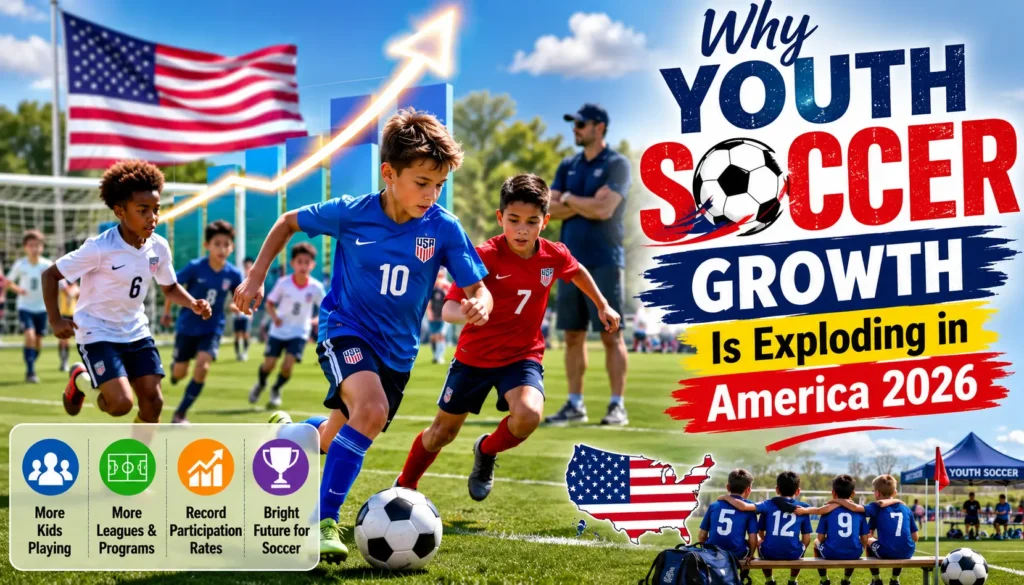

Youth soccer growth in America has shifted from a slow, steady climb into a full-on sprint, and the timing isn’t an accident. The 2026 FIFA World Cup is arriving on home soil. A global superstar is wearing pink in Miami. An entire generation of kids has grown up watching soccer highlights on their phones instead of waiting for a Saturday morning cable broadcast. The sport once dismissed as “not American enough” is having a moment, and the data backs it up.
This is not something people are talking about. It is actually happening and we can see the numbers. The number of people playing soccer in the United States was 16.8 million players in 2025, which is the highest it has ever been and the biggest increase in 15 years according to the Sports & Fitness Industry Association. The number of people playing soccer also went up to 6.6 million which is a new record. Outdoor soccer has a lot of players and kids from 6 to 12 years old are the biggest group, with 5.5 million kids playing outdoor soccer every year.
So what’s actually fueling youth soccer growth in America, and will it last once the World Cup confetti settles? Let’s break down the numbers, the culture shift, and what it means for parents trying to figure out where their kid fits into this boom.
2026 World Cup Stadiums Ranked: Every Venue Rated for the Ultimate Fan Experience
The Numbers Tell the Story of Youth Soccer Growth in America

Start with the headline figure: 16.8 million outdoor soccer participants in 2025, up 15.8% from the year before. That single-year jump is the biggest soccer has seen in a decade and a half of tracked data.
Zoom into who’s actually playing, and the picture gets more interesting. Adults are re-entering the sport at a pace nobody predicted. Americans ages 35–44 grew their outdoor participation by 118% between 2018 and 2025. The 45–54 group grew by an even wilder 247%. These are the kids of the original 1980s and ’90s youth soccer boom, now bringing their own children to practice and lacing up themselves.
Young players are still the backbone of the sport.
Kids aged 6 to 12 make up the group on outdoor fields.This early start is why youth soccer, in America keeps growing over time.A kid who loves the game at 8 years old usually sticks with it through school and college.
Sometimes they even play in adult leagues many years later.Kids who start young tend to stay with soccer.
What’s Driving This Youth Soccer Growth Surge?
No single factor explains a boom this size. It’s a handful of forces hitting at once.
The Messi Effect on Youth Soccer Growth
When Lionel Messi joined Inter Miami in July 2023 people around the world started searching for the club like crazy. We’re talking over 1,200% more searches overnight. This huge interest did not just boost ticket sales.
Many new youth teams were created through US Youth Soccer. 5% More in the months after Messi arrived.
Inter Miami’s youth team is an example.
Since Messi moved to Inter Miami, the club’s youth team has produced players who now play for countries in youth national teams.
This shows that having a superstar like Messi can help bring in young players all the way up through the team’s system, not just at the professional level and Inter Miami and Messi are making it happen.
The 2026 World Cup Fuels Youth Soccer Growth
Hosting the World Cup has an impact than just watching it from far away.
By February 2026 one in four Americans said they would follow the World Cup.
By May that number went up to more than one in three people.
The World Cup is getting more Americans interested.
People who already play soccer are more excited with almost 80% saying they will watch the World Cup.
More people are searching for places to play soccer.
Google searches for “where to play soccer” reached a record high in 2025.
This was months before the World Cup started. People are not just watching soccer highlights. They are looking for a soccer field to join and play.The World Cup is making people want to play soccer.
Hispanic Communities Are Leading Youth Soccer Growth
You do not hear this part of the story often. Hispanic Americans are really making the sport grow. More Hispanic Americans are going outside to play sports. Between 2022 and 2025 the number of Hispanic Americans who play sports outside went up by 60.4 percent. This means that the number of Hispanic Americans who play sports outside increased from 2.6 million to 4.2 million people. Hispanic Americans are now 75 percent more likely to play soccer than the average American.
The cities that will host the World Cup, such, as Los Angeles, Dallas, Houston, Miami and Kansas City have a lot of Hispanic Americans living there. This is great because these cities are where the sport is already getting more popular. The World Cup is being held in the places at the right time, which is where Hispanic Americans are already playing soccer and other sports. Hispanic Americans are driving the growth of the sport. It is happening in these cities.
USMNT 2026 World Cup Roster Surprises: 3 Shocks in Pochettino’s Squad
Girls Are Powering Youth Soccer Growth Even Faster Than Boys

If you look at the numbers there is one thing that should really catch the attention of every youth club. The number of girls playing soccer has increased by 65.5 percent from 2018 to 2025. This is a lot more than the 36.9 percent growth in the number of boys playing soccer.
During this time the percentage of girls playing soccer has gone up from 35.2 percent, to 40 percent of all the players.
This is not just because the U.S. Women’s National Team is well known, although that does help. It is also because there are leagues for girls to play in and more ways for them to get scholarships to play soccer in college.
Soccer is a sport that’s easy for families to get their daughters involved in and this is happening at all ages. The fact that girls’ soccer is growing so much is really the most overlooked thing happening in American sports right now. Girls’ soccer is. It is a big deal. Girls soccer is something that people should pay attention to.
How Youth Soccer Growth Compares to Other American Sports
Soccer is not growing on its own. It has to compete with sports that are changing really fast. Flag football is one of them. It is getting a lot of help from the NFL. This has made flag football the team sport that is growing the fastest among kids who’re 6 to 17 years old. The NFL FLAG program is really big. It has than 620,000 kids in it and it is in all 50 states.
This is actually making things harder for soccer. If we go back to 2012 a lot more kids were playing soccer than flag football. We are talking about kids who were 6 to 12 years 6.4 percent more kids were playing soccer. But by 2024 soccer was not far ahead. It was only 3.5 percent. At the time not, as many kids were playing traditional tackle football and baseball. The number of kids playing these sports went down a bit.
The takeaway: youth soccer growth in America is real, but it’s happening inside a more crowded, more competitive youth sports market than it did twenty years ago. Soccer is winning new fans — it’s just not winning them uncontested.
Roadblocks That Could Slow Youth Soccer Growth
EverCost and access remain the biggest barriers. National youth sports research has found a 20.2 percentage-point gap in regular play rates between higher-income and lower-income families. Club soccer, with its travel teams, tournament fees, and equipment costs, can price out exactly the communities — including many Hispanic families — who are otherwise fueling the sport’s growth.
Field availability is the other quiet problem. Demand for places to play has outpaced the supply of usable fields in many fast-growing metro areas, especially in World Cup host cities where
existing facilities are also being used for tournament prep.y boom has friction points, and soccer’s growth story isn’t immune.
How to Increase Sprint Speed in Football at Home 2026 Without Costly Mistakes
What Parents and Coaches Should Know About Youth Soccer Growth
If you are a parent watching this and wondering if you should get your kid involved in soccer here are a few things you should know.
Recreational leagues are a place to start. You do not need to join a club soccer team right away. Most cities have low-cost recreational leagues for beginners.
MLS academy programs are available for serious players. If your child is really good at soccer, MLS-affiliated academies offer training programs that did not exist before.
Girls have more soccer options than ever before. ECNL Girls Academy and high school soccer programs have increased rapidly.
When to start playing soccer is not as important as you might think. Unlike gymnasts or figure skaters, good high school and college soccer players did not start playing organized soccer until they were 9 or 10 years old.
Coaches are seeing more players sign up. This is especially true in cities that will host the World Cup, where people are excited about soccer and signing their kids up to play.
How to Plan Your 2026 FIFA World Cup Trip: Amazing Fan’s Guide to Navigating Host Cities
The Future of Youth Soccer Growth Beyond the World Cup
What’s different this time is that youth soccer growth in America was already accelerating before the opening match was played. The 2026 tournament is happening in the heart of the domestic outdoor season, on home soil, with a fan base that’s been building momentum for three straight years. If clubs, schools, and local leagues can absorb the new demand—more fields, more affordable options, more bilingual outreach—there’s a real chance this becomes the moment soccer finally cements itself as a top-tier youth sport in the U.S., not just a seasonal curiosity.
FAQs About Youth Soccer Growth in America
Why is youth soccer growing so fast in America? A combination of factors is driving it: record national participation numbers, the arrival of Lionel Messi in MLS, surging Hispanic community involvement, and anticipation around the 2026 World Cup being played on U.S. soil for the first time since 1994.
What age group is driving youth soccer growth the most? Kids ages 6–12 remain the largest single age group playing outdoor soccer in the U.S., with 5.5 million participants. Adults aged 35–54 are also re-entering the sport at historic rates.
Did Messi really cause youth soccer growth in the US? His arrival at Inter Miami in 2023 coincided with a roughly 5% increase in new youth team registrations and a massive spike in public interest, though broader factors like the World Cup and demographic shifts are also major drivers.
Is soccer more popular than football for American kids now? Not yet by total numbers, but the gap is narrowing. Soccer still leads flag football among kids 6–12, though that lead has shrunk significantly since 2012 as flag football expands rapidly.
How is the 2026 World Cup affecting youth soccer growth? Interest in following the tournament rose from 24.4% of Americans in February 2026 to 34.4% by May. Searches for “where to play soccer” hit record highs in 2025, well before kickoff, suggesting real participation interest, not just viewership.
Are girls part of the youth soccer growth trend? Yes, and arguably leading it. Female participation grew 65.5% from 2018 to 2025, nearly double the growth rate among boys over the same period.
What’s the biggest barrier to youth soccer growth in America? Cost and access. Club soccer fees and travel costs disproportionately affect lower-income families, and field availability hasn’t kept pace with rising demand in many growing metro areas.
Final Whistle: The Youth Soccer Growth Wave Is Just Getting Started
Youth soccer growth in America isn’t a flash-in-the-pan reaction to one World Cup or one superstar signing. It’s a multi-year trend built on record participation, a more diverse base of new players, and a generation of girls and boys who see soccer as a normal, mainstream choice — not an alternative to “real” American sports.
The 2026 World Cup will be the loudest moment in this story, but it won’t be the only one. Whether this growth becomes a permanent shift or a temporary spike depends on what happens at the local level: affordable leagues, available fields, and clubs willing to meet new families where they are. The data says the appetite is already there. Now it’s up to the soccer community to keep up with it.


