
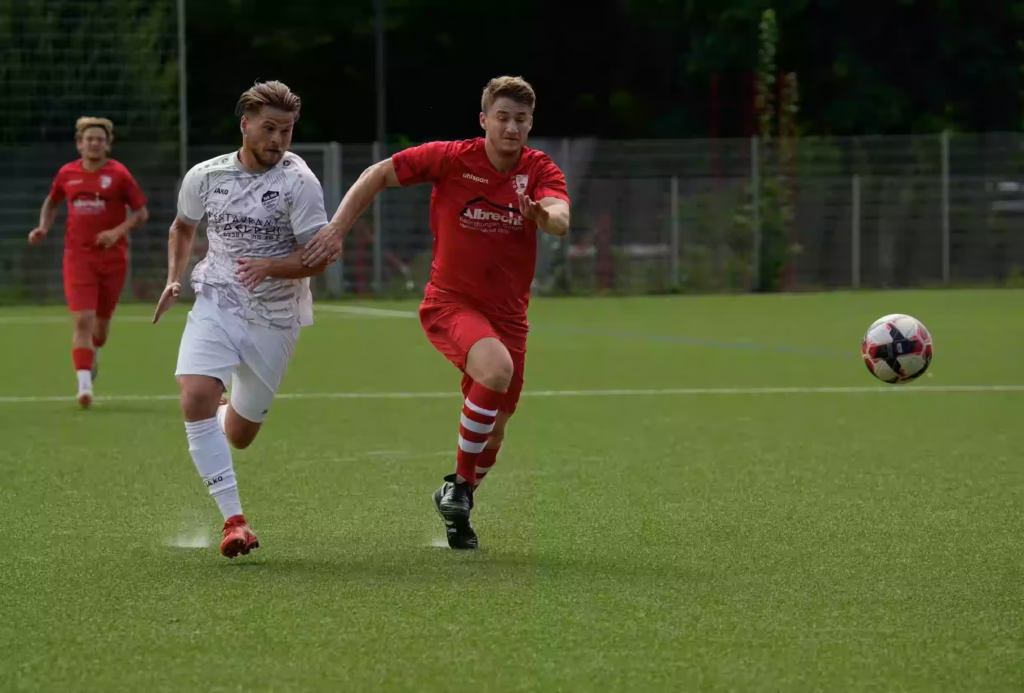

So, how far does a soccer midfielder run per game? Somewhere between 9 and 12 kilometers, on average, more ground than any other position on the pitch. Central and wide midfielders consistently top GPS tracking data across professional leagues, usually with a clear gap over defenders and even most forwards. It’s not just a fun trivia number either. It’s basically a byproduct of the job description: midfielders connect defense to attack, which means they’re covering ground in both directions for most of the match.
Let’s actually dig into what’s behind that number, because the headline figure hides a lot of the interesting stuff.
The Real Range Behind “How Far Does a Soccer Midfielder Run Per Game”
Research across professional leagues keeps landing in roughly the same place, central and wide midfielders somewhere between 9 and 12 kilometers a match, though the exact figure shifts depending on the competition and how a team actually plays. A study analyzing match-running distances at UEFA EURO 2016 found that wide and central midfielders covered noticeably more total distance than defenders and attackers, and that same pattern shows up again and again across Europe’s top leagues, not just at one tournament.
Midfielders Top the List, But It’s Closer Than You’d Think
| Position | Typical Distance Per Match |
|---|---|
| Goalkeeper | 2-5 km |
| Center-back | 7-9 km |
| Full-back / wing-back | 9-11 km |
| Central or wide midfielder | 9-12 km |
| Winger | 9-11 km |
| Striker / center-forward | 8-10 km |
Full-backs and wingers actually creep right up into midfielder territory in plenty of systems, both roles cover serious ground up and down the touchline. Center-backs and goalkeepers sit at the bottom by a mile, which tracks with how much of their job happens in a much smaller patch of the pitch.
Central and Wide Midfielders Aren’t Running the Same Race

Here’s a distinction that gets lost in the average: the running pattern for a central midfielder and a wide midfielder looks pretty different, even when the total distance ends up close. Research on top-class matches using GPS tracking found wide midfielders cover the most ground specifically at very high intensity, while central midfielders rack up more of their total distance jogging and running at a moderate pace. So a wide midfielder’s day looks more like repeated flat-out sprints up and down a flank, while a central midfielder is doing steadier, near-constant movement across a bigger chunk of the pitch.
Total Distance Isn’t Really the Point
A midfielder who covers 11 km mostly walking and jogging had a completely different match than one who covered the same 11 km with a heavy dose of sprinting mixed in. That’s why researchers increasingly lean on high-intensity running distance rather than total distance as the number that actually matters, since two players can post identical totals while working at wildly different intensities. Curious which specific numbers are worth paying attention to beyond the headline figure? Our guide on soccer performance data worth tracking gets into exactly this.
Competition Level and Playing Style Move the Number Around

Distance covered isn’t some fixed physical ceiling, it shifts with tactics, formation, opposition quality, and even the standard of the league itself. Oddly enough, some research has found lower divisions actually producing higher total distance numbers than the top flight, probably because more direct, transition-heavy football at lower levels forces more open-field running than the patient, possession-based style common at the elite level. A high-pressing team is also going to run its midfielders into the ground compared to a team that sits deep and lets the opponent hold the ball.
Some Midfielders Are Genuine Outliers
Every professional league has a handful of high-workrate central midfielders who blow past the typical range, some recorded covering more than 13 km in a single match. If the question “how far does a soccer midfielder run per game” has an extreme-end answer, this is it, these are almost always box-to-box players whose entire job is built around covering the full length of the pitch rather than sitting in one zone, which is exactly why commentators reach for “engine” every time one of these players is on screen.
How Do We Even Know How Far a Soccer Midfielder Runs Per Game?
None of this exists without GPS-based tracking technology, the same systems that are now standard equipment at professional clubs worldwide. Our guide on how soccer teams use GPS tracking covers how that data actually gets collected and used in training decisions. Interestingly, the exact same underlying technology answers a similar question for match officials, our piece on how soccer referee fitness gets measured covers a role that lands in a similar distance range to what outfield defenders typically cover.
Why This Number Should Actually Change How You Train
If midfielder running distance is genuinely this demanding, and the answer to “how far does a soccer midfielder run per game” really does sit at the top of the position rankings, conditioning needs to reflect the role instead of following a one-size-fits-all plan built for the whole squad. Our guide on how often you should actually train soccer covers building a weekly plan around a position this physically taxing, and midfielders juggling a packed match schedule should pay real attention to recovering from overtraining in football, since this kind of running volume adds up faster than people expect. Staying properly fueled matters just as much through a demanding stretch of fixtures, and hydration strategy for multi-game soccer tournaments applies directly if you’re playing several matches in a short window.
Want to see how this workload maps onto specific midfield roles? Our guides on what number 6 means in soccer and what number 10 means in soccer break down how a defensive midfielder’s running pattern actually differs from an attacking midfielder’s, even though both roles land in a fairly similar overall distance range.
Frequently Asked Questions

How far does a soccer midfielder run per game? A soccer midfielder typically runs between 9 and 12 kilometers per game, the highest average of any position on the pitch, with some high-workrate central midfielders exceeding 13 kilometers in individual matches.
Do midfielders run more than defenders? Yes, usually by a clear margin. Center-backs typically cover 7 to 9 kilometers per match, while central and wide midfielders average 9 to 12 kilometers, mostly because midfielders operate across a much larger share of the pitch.
Which runs more, a central midfielder or a wide midfielder? Wide midfielders tend to cover more ground at very high intensity, largely from repeated sprints up and down the flank, while central midfielders log more of their total distance at a steadier, moderate pace across a wider area.
Why do midfielders run more than forwards? Midfielders are involved in both defensive recovery and attacking buildup on nearly every possession, while forwards spend more time in a smaller, more advanced area of the pitch waiting for the right moment.
Is total distance the best way to measure a midfielder’s workload? Not really. High-intensity running distance is increasingly seen as the more meaningful measure, since two players can post identical total distances while working at very different intensities.
How do researchers actually measure how far a soccer midfielder runs per game? Through GPS-based tracking systems worn during matches and training, the same core technology used across professional soccer to monitor player workload, and in a similar form, to track how far referees run during a game.


