
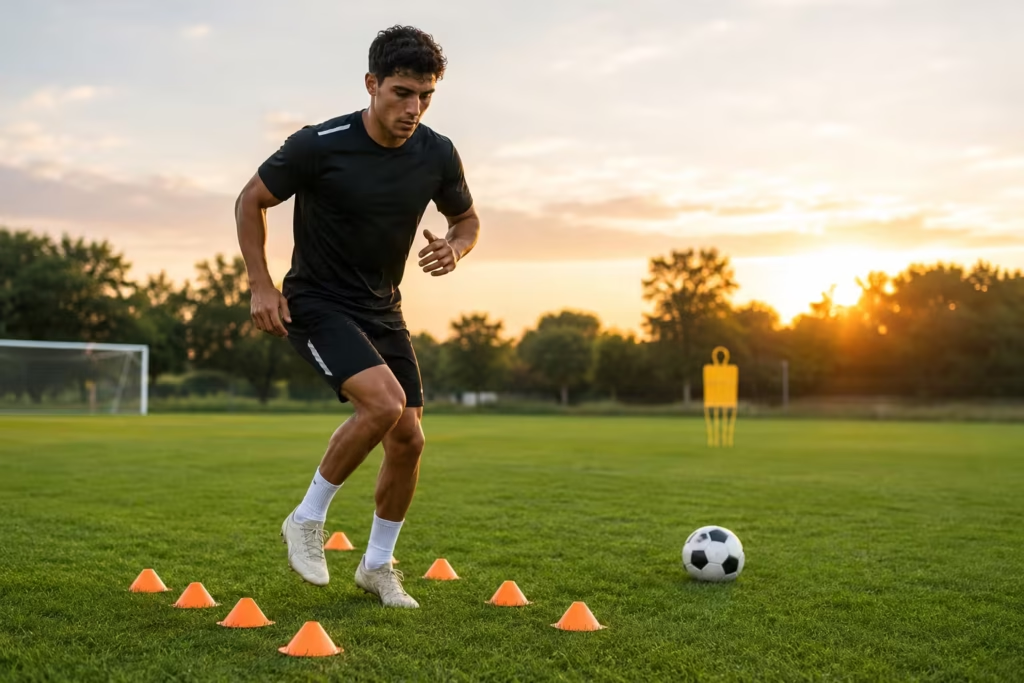

Let’s not waste time. Yes, soccer is a good workout for weight loss. The data backs it up better than most sports you’ll find on a court, a track, or in a gym. I’ve watched a lot of people burn out on treadmills, staring at a number on a screen until they quit. Soccer never felt like that to me — or to the researchers who’ve spent the last twenty years studying it. It just feels like a game. It just happens to also be one of the best fat-burning workouts you can do in a pair of cleats. That’s true whether you’re brand new to the sport or you’re a teenager working toward a college roster spot. Your body burns fat the same way either way.
Now let’s look at the real numbers, not just vibes.
Table of Contents
Is Soccer a Good Workout for Weight Loss? What the Numbers Actually Say

Soccer sits at about 7.0 METs for casual play and up to 10.0 METs when the game gets competitive. That number comes from the Compendium of Physical Activities, which is the standard chart researchers use to measure how hard your body works during exercise. Turn those METs into calories, and you get three different numbers depending on how hard you’re actually playing. If you want to go deeper into what that intensity does to your body, our guide on what player load actually means in football explains the metric coaches use to track it.
Casual Play: About 490 Calories Per Hour
If you’re 70 kg (154 lb) and playing a relaxed pickup game or five-a-side, you’ll burn around 490 calories an hour. Nothing fancy — just normal movement, some jogging, a few short sprints.
Competitive Match: Around 700 Calories Per Hour
Turn up the intensity to a real, competitive match, and that same person burns closer to 700 calories an hour. Almost all of that extra burn comes from sprinting more, not just running more.
Heavier Players: 850–950 Calories Per Hour
Bigger bodies burn more fuel. A 90 kg (200 lb) player can burn 850 to 950 calories an hour in a competitive match, simply because it takes more energy to move more weight.
For comparison, that beats basketball (about 6.5 METs) and roughly matches running at a solid 10 km/h pace. And that’s just the calories burned during play — it’s not the whole story.
Why Soccer Burns More Fat Than a Straight Cardio Session

Here’s my honest take, and the research agrees with me: steady cardio is fine, but it’s nothing special. A 45-minute jog burns calories in a straight, flat line. Soccer doesn’t work that way, and that’s exactly why it’s better.
A match is built from bursts. Sprint. Jog. Sprint. Stand still. Sprint again. That’s basically interval training, except you didn’t have to plan it yourself. This constant switching keeps your heart rate bouncing between moderate and near-max effort for the whole session. That kind of up-and-down effort tends to keep your metabolism running hot even after you’ve stopped moving. So you’re not just burning calories for those 90 minutes. You keep burning a little extra for hours afterward, while your body recovers.
Most “calories burned” charts miss this part completely. Soccer isn’t just a calorie-burning activity — it actually reshapes your body, and the research on that is far more specific than most weight-loss articles give it credit for. Curious exactly which muscles do that work? We break it down in what muscles a soccer ball actually sculpts.
What the Actual Research Says About Soccer and Weight Loss
Time to stop giving you my opinion and hand things over to the scientists. Peter Krustrup and his team at the University of Copenhagen have run some of the most detailed studies on recreational soccer and body composition. A 2022 systematic review with meta-analysis of that research found real, measurable fat-loss results in untrained adults who started playing recreational soccer.
A separate 2025 systematic review and meta-analysis looked at recreational football in overweight and obese adults. The programs ran anywhere from 4 to 48 weeks, and here’s what changed:
- Body fat percentage dropped in a meaningful way across the studies.
- Waist circumference shrank more than any other measurement tracked.
- Lean body mass actually went up — something plain cardio rarely does.
- Resting heart rate and blood pressure both improved, especially in women and in people who started out obese.
- The results were even stronger in younger players (18 and under) and in women.
There’s also older but well-respected research from the same group. It found that 12 weeks of recreational soccer raised VO2 max by 13% on average in untrained men — a bigger jump than a matched group of runners saw in the same amount of time, even at similar heart-rate intensity. In plain terms: soccer trained these men’s hearts and lungs harder than running did. That better conditioning is also why players who train regularly stop running out of gas in the final 20 minutes of a match. A higher VO2 max means the fat-burning intensity holds up deep into the game instead of fading once you get tired.
Here’s my honest take on all this: if fat loss and a better body are your main goals, not just “moving for an hour,” soccer has one of the strongest evidence bases of any team sport out there. That’s not a sales pitch. That’s what shows up when researchers actually measure waistlines and body fat before and after.
How Soccer Stacks Up Against Running, Cycling, and the Gym
No single workout wins at everything, and soccer isn’t magic. Here’s an honest comparison, checked against Harvard Health’s own calorie-burn tables:
| Activity | Calories/Hour (Avg Adult) | Fat-Loss Research Support | Social/Motivation Factor |
|---|---|---|---|
| Recreational soccer | 490–700 | Strong (multiple RCTs and meta-analyses) | High — team format keeps people showing up |
| Running (10 km/h) | ~680 | Strong, well-established | Low-moderate — often solo |
| Cycling (moderate) | 400–600 | Moderate | Moderate |
| Weight training | 200–400 | Strong for lean mass, weaker for pure calorie burn | Moderate |
| Swimming (moderate) | 400–550 | Moderate | Low-moderate |
Soccer’s real advantage isn’t that it burns way more calories than running — on paper, they’re pretty close. The real edge is that people actually show up. A treadmill doesn’t care if you quit after three weeks. A five-a-side team, sort of, does — and that little bit of pressure is worth more for long-term weight loss than any number on a MET chart. If your ball skills are the reason you’re avoiding regular games, our no-nonsense guide to soccer skills and performance is worth reading before your next match.
How Much Soccer Do You Need to Play? (US, UK & Canada Guidelines)
Good news: you don’t need to play like a pro to get the benefits. Health authorities in the US, UK, and Canada all agree on roughly the same baseline, and soccer clears it easily:
- United States (CDC): at least 150 minutes of moderate activity a week, or 75 minutes of vigorous activity.
- United Kingdom (NHS): the same target for adults aged 19 to 64 — 150 minutes moderate, or 75 minutes vigorous, spread through the week.
- Canada (24-Hour Movement Guidelines): at least 150 minutes of moderate-to-vigorous activity a week, in chunks of 10 minutes or more.
One competitive 90-minute match, played once or twice a week, easily meets or beats all three guidelines on its own — and that’s before you count practice or a casual weekend kickabout. Play twice a week, and you’re well past the “extra benefits” line that all three guidelines mention for going beyond the minimum.
Can You Lose Weight Playing Soccer Without Changing Your Diet?
Let me be straight with you here, because a lot of fitness articles won’t be. Soccer is genuinely great for weight loss, but it’s not a cheat code around your diet. You can play two matches a week and still not lose weight if your eating habits work against you. That’s just basic energy balance, and no MET number changes it. A 700-calorie match can be wiped out by one burger-and-fries meal afterward — a standard cheeseburger meal with fries runs roughly 800 to 1,190 calories, depending on size. That’s exactly why the strongest results in the research above came from people who paired soccer with at least some basic awareness of what they were eating, not soccer alone.
What soccer does give you is a workout that:
- Doesn’t feel like punishment, so you’re far more likely to stick with it for the long run.
- Builds real cardio fitness and lean muscle alongside fat loss, not just a smaller number on a scale.
- Comes with a built-in reason to show up — teammates, a set schedule, a game on the calendar even on days you don’t feel like moving.
In my honest opinion, that combination beats almost any solo cardio routine for long-term weight loss. Not because it burns more calories per hour, but because you’ll actually keep doing it. Showing up matters more than any single workout’s intensity, month after month.
Tips to Get the Most Fat-Loss Benefit from Soccer
Play at Least Twice a Week
Once a week hits the baseline guideline. Twice a week is where results start speeding up if weight loss is your specific goal. Struggling to fit in a second session? Our 10-minute soccer practice routine for beginners is built for exactly that — extra reps without needing a full pickup game.
Don’t Skip the Sprints
Most of the post-match calorie burn comes from the high-intensity bursts. Jog through a match instead of sprinting, and you’ll blunt that effect quite a bit. Our guides on increasing sprint speed and beginner acceleration drills both target this directly.
Pair It With Basic Strength Work
Two short strength sessions a week protect the lean muscle you’re building on the field and keep your metabolism on your side, not against it. Our guide to building explosive leg power at home is a good place to start if you don’t have gym access.
Track Food, Not Just Fitness
Even a rough daily food log stops the classic “I exercised, so I can eat whatever I want” trap — the exact trap the burger-and-fries example above shows. Pair a food log with a simple performance log, like the one in our guide on tracking soccer performance at home without equipment, and you’ll get a much clearer picture of whether your training is actually working.
Prioritize Recovery
Sore, tired, under-slept players skip sessions. And consistency, not intensity, is what actually drives the fat-loss numbers in the research above.
FAQ

Is soccer a good workout for weight loss? Yes. Recreational soccer burns roughly 490 to 700 calories an hour, depending on intensity. Several systematic reviews link regular recreational soccer to real drops in body fat percentage, waist size, and body weight in untrained and overweight adults.
How many calories does soccer burn compared to running? They’re close. Soccer burns about 490 to 700 calories an hour at recreational intensity, versus roughly 680 calories an hour running at 10 km/h. Soccer’s start-stop bursts may stretch out the calorie burn a bit after the game ends, compared to a steady-pace run.
How often should I play soccer to lose weight? One 90-minute match a week meets US, UK, and Canadian activity guidelines on its own. For faster fat-loss results, studies generally used two to three sessions a week over 8 to 16 weeks.
Does soccer build muscle as well as burn fat? Yes. Studies on recreational soccer have recorded gains in lean body mass right alongside fat loss — a combo that plain cardio alone usually doesn’t produce.
Is soccer better than the gym for weight loss? Neither one is objectively “better.” They just work differently. Soccer tends to win on long-term consistency because it’s social and game-based, while gym training gives you more precise control over building strength. The best results in the research often came from people doing both.
Author’s Note
Written by Tommy Jackson, Editor at Sports Wink, referencing peer-reviewed sports science research from the University of Copenhagen’s football-health research group and current national physical activity guidelines from the CDC, NHS, and Canadian 24-Hour Movement Guidelines. Reviewed for accuracy against current exercise science literature.


