

You know that feeling.
The match is still alive, the crowd is loud, but your legs feel like concrete. You’re chasing the game, not controlling it. I’ve been there. Every serious player has.
The truth? Talent fades fast without endurance. That’s why mastering soccer stamina training tricks is what separates average players from those who dominate the final minutes.
In this guide, I’ll walk you through proven, science-backed methods used across the USA, UK, and Canada that will help you stay sharp from kickoff to the final whistle.
Building stamina is only one part of becoming a complete athlete. Understanding your performance, strengthening your mindset, and following the right nutrition plan all work together to improve results on the field. If you’re serious about long-term development, explore our guides on Nutrition Plans for Young Athletes: The Fuel That Builds Champions
Table of Contents
Why Soccer Stamina Training Tricks Matter More Than You Think

Soccer isn’t just running. It’s repeated sprint ability (RSA), recovery speed, and mental resilience.
A typical player:
- Runs 9–13 km per match
- Performs 30–40 high-intensity sprints
- Changes direction hundreds of times
Without proper soccer stamina training tricks, fatigue hits early. And once it hits, your decision-making drops. Your touch gets heavy. You become predictable.
To truly understand how to improve performance, it also helps to learn how elite players track progress. If you want to go deeper, check out this guide on how to analyze sports performance data to measure your improvements the right way.
The Science Behind Soccer Fatigue
Before we start looking for answers, we need to understand what the problem is.
- Fatigue in soccer happens because of a thing.
- It comes from things like glycogen depletion, which’s when your fuel tank runs empty.
- It also comes from lactic acid buildup, which’s when your muscles get tired.
- Then there is neuromuscular fatigue, which is when your brain and muscles do not talk to each other as well as they should.
In North America and Europe, the way they train soccer players is focused on a few key things:
- They focus on endurance, which is the ability to keep going for a long time.
- They also focus on bursts, which are short bursts of energy.
- They focus on recovery efficiency, which is how well the soccer players can recover from fatigue in soccer.
- Fatigue in soccer is a problem, and we need to understand it to fix it.
The best soccer stamina training tricks combine all four.
Physical endurance is only one side of the equation. Mental fatigue also affects decision-making and concentration during the final minutes of a match. Our guide 7 Sports Psychology Tips to Boost Athlete Confidence Fast/ on explains how mental resilience helps players maintain peak performance under pressure.
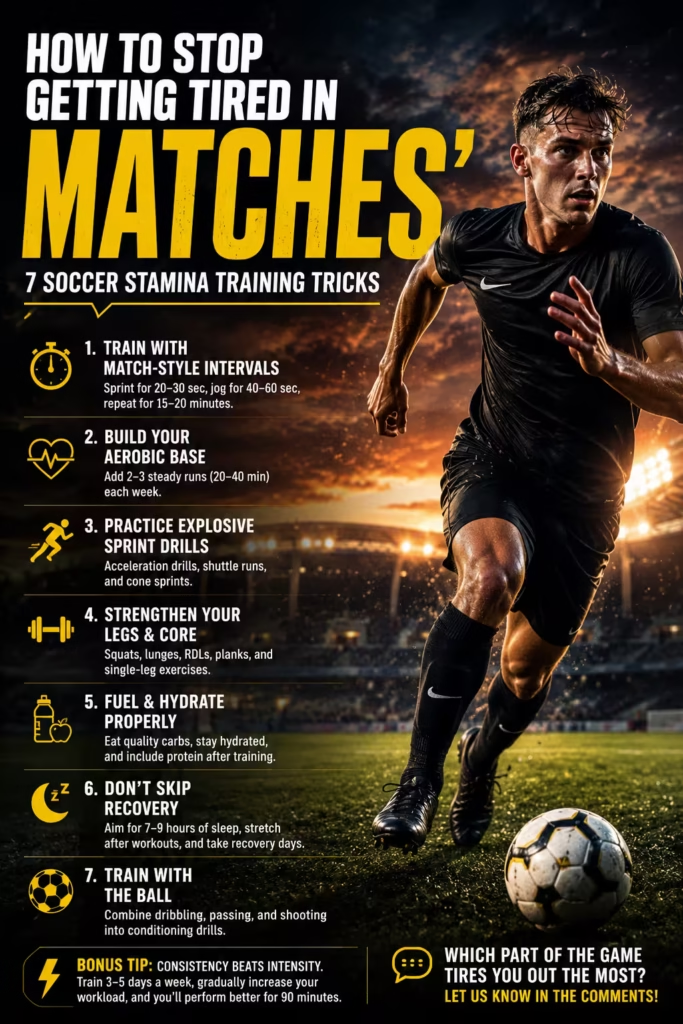
7 Soccer Stamina Training Tricks That Actually Work

Let’s get practical. These are not gimmicks. These are methods used by elite academies and pro teams.
1. High-Intensity Interval Training (HIIT) for Soccer Stamina Training Tricks
If you only run long distances, you’re training wrong.
Soccer is stop-start. So your training should be too.
Try this:
- Sprint 30 seconds
- Jog for 60 seconds
- Repeat 10–15 times
Why it works:
- Mimics match conditions
- Improves recovery between sprints
- Boosts VO2 max
This is one of the most powerful soccer stamina training tricks you can implement immediately.
If you’re looking to build explosive power alongside endurance, you should also learn 7 Proven Ways to Measure Vertical Jump at Home Accurately (Step-by-Step Guide). Tracking your jump performance is an excellent way to monitor improvements in lower-body strength and athletic power.
2. Small-Sided Games for Soccer Stamina Training Tricks
Honestly, this is my favorite method.
Play 3v3 or 5v5 in tight spaces.
Benefits:
- Constant movement
- More touches
- Higher intensity than full matches
Coaches in the UK use this heavily because it builds:
- Stamina
- Decision-making
- Technical sharpness under fatigue
It’s one of the most enjoyable soccer stamina training tricks—and it doesn’t feel like conditioning.
3. Tempo Runs for Soccer Stamina Training Tricks
Not every workout session should be really tough on you.
Tempo runs are great for building an aerobic base for running. They really help. For example:
- Run at seventy percent effort for twenty minutes
- Try to maintain breathing while you are running.
This really improves your running. It also helps with recovery between actions, like sprinting.
Many Canadian training programs use this method to balance intensity and recovery for the runners.
4. Strength Training for Soccer Stamina Training Tricks
Here’s something most players ignore.
Stronger muscles = less fatigue.
Focus on:
- Squats
- Lunges
- Deadlifts
- Core work
Why it matters:
- Reduces energy waste
- Improves running efficiency
- Prevents injury
In my opinion, this is the most underrated of all soccer stamina training tricks.
5. Sprint Repeat Drills for Soccer Stamina Training Tricks
Matches are won in bursts. You need to get your body ready to bounce fast between sprints.
To do that, you can try this drill:
- Sprint 20 meters
- Rest for 20 seconds
- Do that again and maybe 10 to 20 times.
This drill helps you with things like being explosive and recovering quickly, which is pretty realistic for a match. It is about matches and how matches are won in bursts, so you have to focus on matches and train for matches.
Elite academies in the USA prioritize this as a core soccer stamina training technique.
6. Proper Nutrition & Hydration for Soccer Stamina Training Tricks
You cannot outtrain a diet.
Food is really important:
- Before you play matches, it is an idea to eat things like carbs, such as rice or pasta or oats, and also some protein, but not too much of it.
- During matches you need to drink a lot of water and also make sure you have electrolytes.
- After matches you should eat protein and carbs so your body can recover from all the exercise.
- Food like protein and carbs are good for the body after matches because they help it recover.
Before matches, carbs are food to eat because they give you energy.
Without proper nutrition, even the best soccer stamina training tricks won’t work.
7. Recovery & Sleep for Soccer Stamina Training Tricks
This is where gains actually happen.
Most players train hard but recover poorly.
Focus on:
- 7–9 hours of sleep
- Stretching
- Light recovery sessions
Fatigue accumulates silently. Recovery resets your system.
This is the final piece of effective soccer stamina training tricks.
Weekend players often underestimate the importance of recovery between training sessions read The Science of Weekend Athletes: 7 Proven Reasons 2-Day Training Works. Our article on explains how proper recovery, sleep, and training balance can significantly improve athletic performance while reducing injury risk.
Weekly Training Plan Using Soccer Stamina Training Tricks
Here’s a simple structure:
Monday: HIIT + Strength
Tuesday: Small-sided games
Wednesday: Rest or light tempo run
Thursday: Sprint drills
Friday: Tactical + light session
Saturday: Match day
Sunday: Recovery
Consistency beats intensity over time.
Common Mistakes That Kill Your Stamina
Let’s be real. Many players sabotage themselves.
Avoid these:
- Only doing long-distance running
- Ignoring strength training
- Poor sleep habits
- Skipping warm-ups
- Overtraining without recovery
Even with great soccer stamina training tricks, these mistakes will hold you back.
Many of these mistakes are caused by poor planning rather than lack of effort. Monitoring your training intensity with helps prevent overtraining while ensuring steady progress throughout the season.
My Honest Take on Soccer Stamina Training Tricks
If I had to simplify everything:
- Train like the game is played
- Respect recovery
- Stay consistent
I’ve seen players transform in 6–8 weeks just by applying these principles.
Stamina isn’t talent. It’s built.
FAQs About Soccer Stamina Training Tricks
How long does it take to improve stamina in soccer?
You’ll notice improvements in 2–4 weeks, but real transformation takes 6–8 weeks with consistent training.
Can I improve stamina without running?
Not really. You need running, but it should be game-specific (HIIT, sprints, small-sided games).
What should I eat before a match?
Focus on carbs like pasta or rice 3–4 hours before kickoff. Keep it light and digestible.
How often should I train stamina?
3–4 times per week is ideal. Balance intensity with recovery.
Do professional players train stamina daily?
No. They periodize training—mixing intensity, recovery, and tactical work.
Why do I get tired so fast in matches?
Usually due to:
- Poor conditioning
- Weak aerobic base
- Bad nutrition
- Lack of recovery
Are supplements necessary for stamina?
Not essential. A balanced diet works for most players. Supplements are secondary.
Final Thoughts
Getting tired in matches isn’t a mystery. It’s a signal.
A signal that your body needs smarter training.
Apply these soccer stamina training tricks consistently, and you’ll feel the difference:
- Stronger runs
- Faster recovery
- Better performance under pressure
And the best part?
You’ll still have energy when others don’t.
That’s where games are won.
For deeper scientific insight into endurance training, I recommend:
FIFA Training Centre Fitness Guide


