
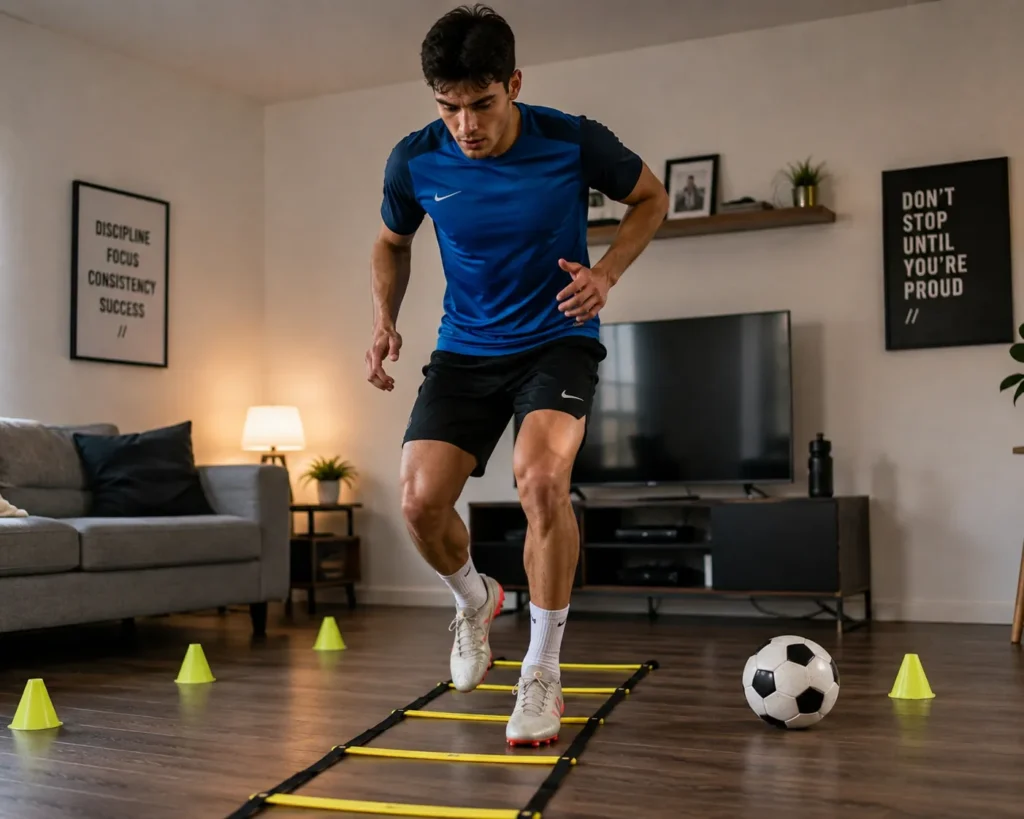

Introduction: No Field? No Problem.
How to train soccer in your room without making noise is one of the most common challenges for beginners—and the good news is, it’s completely possible.
Let’s be honest—most people don’t have a football field in their backyard.
Maybe you live in an apartment. Maybe your space is small. Or maybe you just don’t want to disturb your family or neighbors.
Here’s the truth:
You can still become a better soccer player—right in your room—without making noise.
And in many cases, this type of training gives you an edge. When space is limited, you’re forced to develop tighter control, quicker reactions, and better awareness—skills that directly translate into real matches.
Table of Contents
How to Train Soccer in Your Room Without Making Noise (Start With This Mindset)

Indoor training is not about power—it’s about precision.
Follow these three rules:
Keep Everything Soft
Every touch should be controlled. No kicking or striking.
Stay on the Ground
Keep the ball rolling—no bouncing or loud juggling.
Use Quiet Equipment
- Foam ball
- Futsal ball
- Rolled-up socks
How to Train Soccer in Your Room Without Making Noise Using Ball Control Drills
Toe Taps (Quiet Version)
Lightly tap the ball with alternating feet.
Stay relaxed and build rhythm.
Inside-Outside Touch Drill
Move the ball using the inside and outside of your foot.
- Keep touches tight
- Stay in control
Sole Rolls
Roll the ball side to side using your sole.
- Smooth and silent
- Builds elite control
V-Pull Drill
Pull the ball back, then push it forward diagonally.
- Improves direction changes
- Helps in tight spaces
How to Train Soccer in Your Room Without Making Noise Without a Ball

Fast Feet Drill
Run in place on your toes.
- Light steps
- Quick movement
To take this further, combine it with explosive drills like those in
soccer acceleration drills for beginners
Shadow Movement
Move as if you’re in a real match.
- Defending
- Attacking
- Turning quickly
This builds game awareness similar to what’s explained in
playing better soccer skills guide
Balance Training
Stand on one leg for 30–60 seconds.
- Improves stability
- Enhances control
How to Train Soccer in Your Room Without Making Noise (Simple Daily Routine)
You only need 10–15 minutes.
Beginner Routine
Warm-up (2 minutes)
- Light jogging
- Ankle mobility
Ball Control (5 minutes)
- Toe taps
- Sole rolls
- Inside-outside touches
Movement (5 minutes)
- Fast feet
- Shadow drills
Cooldown (2–3 minutes)
- Stretch
- Relax
Stick to this daily, and you’ll see progress quickly.
To build a complete habit system, follow this structured routine:
10-minute soccer practice routine for beginners
Best Setup for Quiet Soccer Training at Home
Ideal Surface
- Carpet
- Yoga mat
- Rug
Best Ball Options
- Foam ball
- Futsal ball
- Sock ball
How This Connects to Real Performance
Training indoors builds control—but you also need physical development.
Combine this routine with:
These help turn your control into real match performance.
Common Mistakes Beginners Make
Training Too Fast
Leads to noise and poor technique.
Ignoring Control
Precision matters more than speed.
Inconsistency
Daily training is key.
Wrong Equipment
Noise reduces motivation.
Improve Smarter With Tracking
If you want faster results, track your progress using simple methods:
track soccer performance at home
This helps you measure improvement and stay consistent.
You can also understand deeper metrics like:
player load in football explained
Build Stamina and Avoid Fatigue

Indoor training improves skill—but stamina matters too.
Pair this with:
Bonus: Long-Term Growth
If you’re serious about improving, also explore:
FAQ: How to Train Soccer in Your Room Without Making Noise
Can I really improve without going outside?
Yes. Indoor training builds control, coordination, and awareness.
What can I use if I don’t have a ball?
Rolled-up socks work perfectly.
How long should I train?
10–20 minutes daily is enough.
Is indoor training enough?
It builds strong fundamentals. Combine with outdoor play for best results.
Will this help in real matches?
Yes. Better control and movement directly improve performance.
For deeper fundamentals on training principles, you can refer to official guidance from:
FIFA Training Centre
Final Thoughts
You don’t need space, money, or a field to improve.
You need:
- A small area
- A simple routine
- Consistency
Train quietly. Train smart. And start today.


