
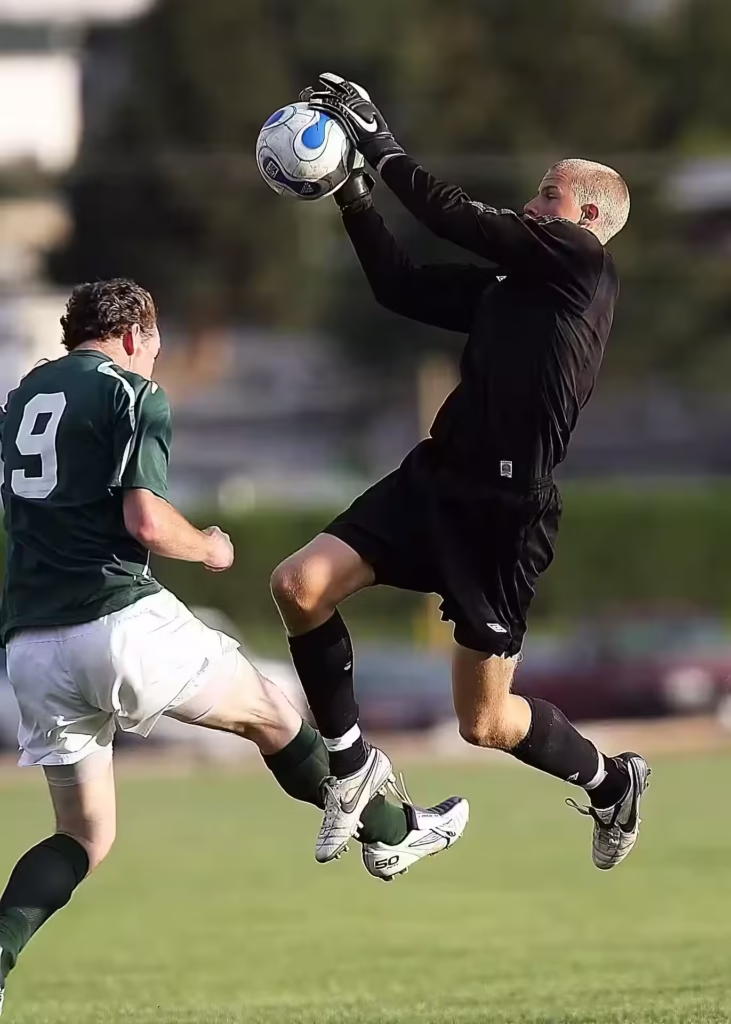

Goalkeeper training at home is one of the fastest ways to sharpen your reflexes without waiting for team practice, a coach, or even a full-size goal. All you really need is a wall, a ball, and about 15–20 minutes a few times a week. In this guide, you’ll get 10 easy, research-backed reflex drills you can start today, plus a simple weekly structure so your reaction speed keeps improving instead of plateauing.
Reaction time is one of the biggest separators between an average goalkeeper and a great one. Research on elite goalkeepers by Piechota et al. (2023) found that experienced keepers react in roughly 250–260 milliseconds, compared to 300–320 milliseconds for novices — a gap of less than a third of a second that often decides whether a shot ends up in the net or in your hands. The good news: reaction time is trainable, and you don’t need a training facility to build it.
Why Goalkeeper Training at Home Works for Reflex Development

Reflexes aren’t just raw talent — they’re a skill built through repetition, and repetition is exactly what home training gives you. A coached session might only give you 10–15 real reaction reps in an hour. Training alone against a wall, you can rack up 100+ reps in the same time, because there’s no waiting in line, no setup between shots, and no wasted time.
Home reflex training also isolates the two things that actually build faster reactions:
- Visual processing speed — how quickly your eyes pick up the ball’s flight or a change in direction
- Motor response speed — how quickly your hands, feet, and body translate that visual information into a save
Because you control the speed and unpredictability yourself, you can progressively overload both without needing a full squad around you.
What You Need Before You Start Goalkeeper Training at Home
Keep it simple. Most goalkeeper training at home requires almost no equipment, and a rebounder or reaction ball is a nice-to-have, not a must-have:
- A soccer ball (a size 4 or 5 works fine)
- A flat wall, garage door, or rebounder
- A small, textured “reaction ball” if you have one (its irregular bounce is great for training unpredictability, though a regular ball works too)
- Comfortable indoor or turf shoes with good grip
- Roughly 6–10 feet of clear space
If you’re working with limited room — an apartment, a garage, or a shared living space — pair this routine with our guide on how to train soccer in your room without making noise, which covers low-impact setups that won’t disturb neighbors or housemates.
10 Easy Reflex Drills for Goalkeeper Training at Home
Each of these drills takes 2–3 minutes. Work through them in short, focused bursts rather than long, tired sets — quality reps train your nervous system; sloppy ones just train bad habits.
1. Wall Rebound Catches
Stand about 3 feet from a wall and throw the ball firmly against it, catching the rebound with soft hands. This is the foundation drill of goalkeeper training at home because it trains hand-eye coordination under a fixed, predictable rhythm before you add chaos.
- 3 sets of 15–20 reps
- Focus on “W” hand shape and absorbing the ball, not just stopping it
2. Tennis Ball Reaction Drops
Hold a tennis ball at shoulder height and drop it, trying to catch it before the second bounce. This trains pure visual-to-hand reaction speed with almost zero equipment.
- 10 drops per hand, then 10 with both hands
- Increase difficulty by dropping from a slightly higher point
3. Two-Ball Call-Out Drill
Have a partner hold two different colored balls and call out which one to catch just before releasing it. This mimics the split-second decision-making goalkeepers face when a shot changes path late.
- 3 sets of 8–10 reps
- If training solo, use two different-sized balls and alternate randomly yourself
4. Mirror Reaction Drill
Face a partner (or your reflection) and mirror their quick hand or foot movements before reacting to a thrown ball. This blends anticipation training with reflex training, which is exactly how real shots are read in a match.
- 3 rounds of 30 seconds
- Great warm-up before higher-intensity drills
5. Turn-and-React Drill
Stand with your back to the thrower. On a verbal cue, spin and react to an incoming shot or throw as fast as possible. This is one of the most effective drills in goalkeeper training at home because it removes any early visual cue, forcing a true reflex response.
- 8–10 reps per side
- Keep the throw distance short (6–8 feet) to keep reactions sharp, not just physically demanding
6. Star Jump to Save
Perform a star jump, and the instant you land, react to a ball thrown or shot at you. This trains reflexes under mild physical fatigue, which is closer to real match conditions than standing still and waiting.
- 3 sets of 8 reps
- Rest 30–40 seconds between sets to keep reaction quality high
7. Stair or Step Reaction Bounce
If you have a single step or low stair, bounce a ball down it and react to the unpredictable rebound angle. This is a low-cost substitute for a deflection ramp and builds comfort with the kind of chaotic bounces that happen in a crowded penalty box.
- 10–12 reps
- Always keep the ball speed controlled — this drill is about reaction, not power
8. Blind Reaction Save
Close your eyes, have a partner count “1-2-save,” and open your eyes only on “save” to react to the ball already in flight. This compresses your reaction window intentionally, which builds explosive first-step speed.
- 8 reps
- Use a soft ball for safety when starting out
9. Low Dive Reflex Roll
Kneel or crouch low and react to balls rolled or bounced just outside your reach on either side, focusing on a quick, safe collapse dive. This drill teaches your body to react instinctively at ground level, where many goals are actually conceded.
- 3 sets of 6 reps per side
- Train on a soft surface (grass, mats, or turf) to protect your hips and elbows
10. Rapid-Fire Close Range Saves (With a Partner)
From 6–8 yards, have a partner fire a quick series of shots or throws with almost no gap between them. This is the closest home drill to real match pressure and should be the finishing drill of your goalkeeper training at home session.
- 3 sets of 6–8 shots
- Stop the set the moment your form breaks down — this drill is about sharp reactions, not endurance
How to Structure Your Goalkeeper Training at Home Weekly Routine
Consistency beats intensity when it comes to reflexes. A simple, sustainable structure looks like this:
- 2–3 sessions per week, 20–30 minutes each
- Start with drills 1–4 (lower intensity, higher rep count) as a warm-up block
- Move into drills 5–8 (decision-making and reaction speed)
- Finish with drills 9–10 (match-realistic, higher intensity)
- Always leave at least one full rest day between sessions
If you want a broader weekly plan that fits goalkeeper-specific reflex work alongside general soccer conditioning, our guide on how often you should train soccer breaks down proven weekly training splits for different playing levels.
Common Mistakes to Avoid During Goalkeeper Training at Home
Even well-intentioned goalkeeper training at home can backfire if you fall into these habits:
- Training too fast, too soon — jumping straight to high-speed drills before your base reaction pattern is solid
- Skipping rest between sessions — reflexes actually improve during recovery, not just during training; see our breakdown of why rest matters more than extra training
- Ignoring early fatigue or soreness signs — reaction drills feel light on the muscles but are demanding on the nervous system; if you’re consistently sluggish, review the signs covered in how to recover from overtraining in football
- Only training hands — footwork gets you into position to make the save in the first place; neglecting it undercuts every drill above
- Practicing until exhausted — tired reflexes are slow reflexes; stop while your reactions are still sharp
How Goalkeeper Training at Home Complements Your Overall Soccer Development
Reflexes are only one piece of becoming a complete goalkeeper. Positioning, footwork, and overall athleticism matter just as much, and they’re worth training alongside your reflex work:
- If you’re building general athleticism, it’s worth understanding whether gym training actually slows you down in soccer before adding heavy lifting to your schedule
- Outfield skills like close control also transfer to goalkeepers who play out from the back — see our guide on how to fix poor dribbling in soccer
- If you’re competing in tournaments, don’t overlook recovery basics like our hydration strategy for multi-game soccer tournaments
- Considering a structured program? Our guide to the best soccer camps in America covers where goalkeepers can get hands-on coaching to build on home training
FAQ: Goalkeeper Training at Home

How long should goalkeeper training at home sessions last?
20–30 minutes, 2–3 times per week, is enough for most players. Reflex training relies on sharp, high-quality reps, so shorter, focused sessions beat long, tiring ones.
Can I improve goalkeeper reflexes without a partner?
Yes. Wall rebounds, tennis ball drops, and stair bounce drills only require a wall or a step, making them ideal for solo goalkeeper training at home. A partner adds value for drills like the two-ball call-out and rapid-fire saves, but isn’t required to get started.
How soon will I see results from home reflex drills?
Most goalkeepers notice sharper hand reactions within 3–4 weeks of consistent training (2–3 sessions per week). Full reaction-time gains, similar to the improvements seen in trained versus untrained keepers, typically build over 8–12 weeks of regular practice.
Is a reaction ball necessary for goalkeeper training at home?
No. A reaction ball’s irregular bounce is useful for adding unpredictability, but a standard soccer ball or tennis ball works well for every drill in this guide, especially for beginners still building fundamental hand-eye coordination.
What’s the biggest mistake goalkeepers make with reflex training?
Training at maximum speed and intensity from day one. Reflex development works best when you build a clean movement pattern at a controlled pace first, then gradually increase speed and unpredictability as your form holds up.


