
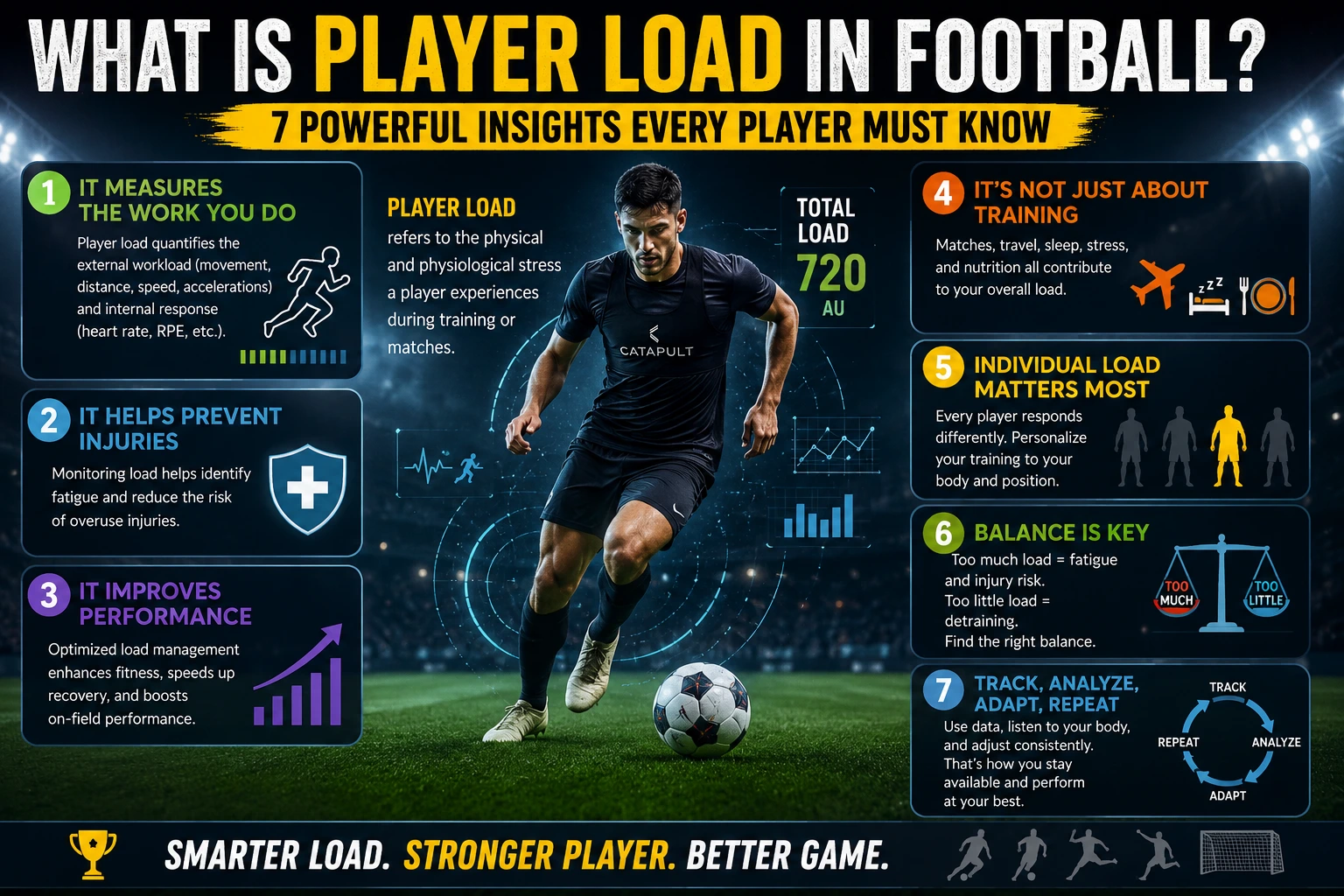

Football has entered a new era where performance is no longer judged by goals and assists alone. Behind every sprint, tackle, and movement lies valuable data that can transform how players train and perform.
Player load is one of the most important concepts in modern sports science. If you’ve ever been curious about how elite teams manage fatigue, avoid injuries, and perform at their best throughout the season, it often comes down to an understanding of this metric.
In this guide, you’ll learn what is player load in football, how it works, why it matters, and how you can use it to improve your performancewhether you’re a beginner, amateur, or professional.
What Is Player Load in Football?
At its simplest, player load in football is a measurement of the total physical stress placed on a player during training or matches.
It goes beyond basic stats like distance covered. Instead, it captures the intensity and effort behind every movement.
What Player Load Includes:
- Speed up (increase of speed)
- Deceleration (braking)
- Directional changes
- Physical contact and effects
- Power of movement
This provides a more accurate measure of real performance than traditional metrics.
How Is Player Load Measured in Football?
To fully understand what is player load in football, you need to know how it’s calculated.
Player load is measured using wearable GPS trackers equipped with accelerometers. These devices are usually worn in a vest under the jersey.
How the Technology Works:
The tracker records movement across three axes:
- X-axis: Side-to-side movement
- Y-axis: Forward and backward movement
- Z-axis: Vertical movement (jumping, landing)
All these movements are combined into a single number that represents total workload.
Why Player Load Is Important in Football
Understanding what is player load in football is essential because it directly impacts performance, recovery, and injury risk.
1. Injury Prevention
One of the biggest benefits of tracking player load is reducing injuries.
When players train too hard without proper recovery:
- Muscles fatigue
- Reaction time slows
- Injury risk increases
Monitoring load helps coaches avoid overtraining.
2. Performance Optimization
Player load helps ensure players are training at the right intensity.
Benefits include:
- Improved stamina
- Better match fitness
- Increased efficiency in training
3. Smarter Training Decisions
With player load data, coaches can:
- Adjust training intensity
- Plan recovery sessions
- Rotate players effectively
Types of Player Load in Football
To better understand what is player load in football, it’s important to distinguish between two main types.
External Load
This refers to the physical work performed.
Examples include:
- Distance covered
- Sprint count
- Acceleration movements
Internal Load
This measures how the body responds to that work.
Examples include:
- Heart rate
- Fatigue levels
- Perceived exertion
Combining both provides a complete picture of performance.
Player Load vs Distance Covered: What’s the Difference?
Many players assume distance is the best measure of effort—but that’s not always true.
Distance Covered:
- Measures how far you run
- Does not reflect intensity
Player Load:
- Measures total effort
- Includes speed changes and impacts
A player who sprints, stops, and turns frequently will have a higher player load, even if they run less distance.
What Is a Good Player Load in Football?

There is no single “perfect” number when it comes to player load in football.
It depends on several factors:
- Position (defender, midfielder, forward)
- Fitness level
- Training intensity
- Match demands
General Guidelines:
- Low load: Recovery sessions
- Moderate load: Standard training
- High load: Matches or intense sessions
The goal is not to maximize load, but to manage it effectively.
How to Use Player Load in Football Training
Now that you understand what is player load in football, let’s look at how to apply it.
1. Track Every Session
Consistency is key.
Track:
- Training sessions
- Matches
- Recovery days
2. Compare Training to Match Demands
Your training should prepare you for real match conditions.
Ask:
- Are you reaching similar sprint levels?
- Is your training intensity high enough?
3. Avoid Sudden Increases
Sudden spikes in workload are a major cause of injuries.
Increase load gradually (10–15% rule).
4. Monitor Fatigue
Signs of excessive load:
- Decreased performance
- Slower sprint speed
- Increased soreness
Adjust training when needed.
5. Customize Training by Position
Different roles require different physical demands.
- Midfielders → High endurance
- Wingers → Sprint speed
- Defenders → Explosive movements
Common Mistakes When Using Player Load
Even with good data, mistakes can happen.
Ignoring Recovery
Tracking load is useless without proper recovery.
Focusing Only on Numbers
Player load is a guide—not the full picture.
Always consider how you feel physically.
Comparing With Other Players
Every athlete is different.
Focus on your own progress.
Real-Life Example of Player Load in Football
That’s how it breaks down:
Player A:
- Runs 9 km
- Mostly jogging
B: Player B
- It has a length of 7km.
- High-speed intensity
Player B will probably have a higher player load.
This emphasizes the importance of load rather than distance per se.
Benefits of Understanding What Is Player Load in Football
When you understand this concept, you gain a real advantage.
Key Benefits:
- Improved training decisions
- Lower injury risk
- Better match performance
- Intelligent workload management
- A faster development as a player
Conclusion: Train Smarter With Player Load
Understanding what is player load in football is no longer optional—it’s essential for modern players and coaches.
It allows you to:
- Train with intent
- Avoid needless injuries
- Enhance performance in all respects
Sometimes, the ability to manage workload is the difference between average and elite players.
Pay attention to your player load and you’ll see better results on the pitch.
You can also visit Best GPS Trackers for Football Players: Ultimate Guide for 2026
FAQ: What Is Player Load in Football
1. What is player load in football?
Player load is a metric that measures the total physical stress placed on a player using movement data such as acceleration and intensity.
2. How is player load calculated?
It is calculated using accelerometer data from GPS devices that track movement in multiple directions.
3. Why is player load important?
It helps prevent injuries, improve performance, and manage training intensity effectively.
4. What is a good player load value?
There is no fixed value. It depends on the player’s position, fitness level, and training intensity.
5. Can beginners use player load tracking?
Yes. Even beginner players can benefit by tracking workload and improving training efficiency.
What You Should Do Next
- Start logging your workouts
- Keep track of your workload regularly
- Modify intensity based on your data
The more you understand your body, the better you perform.


