

Table of Contents
What is AI in Soccer Decision-Making?

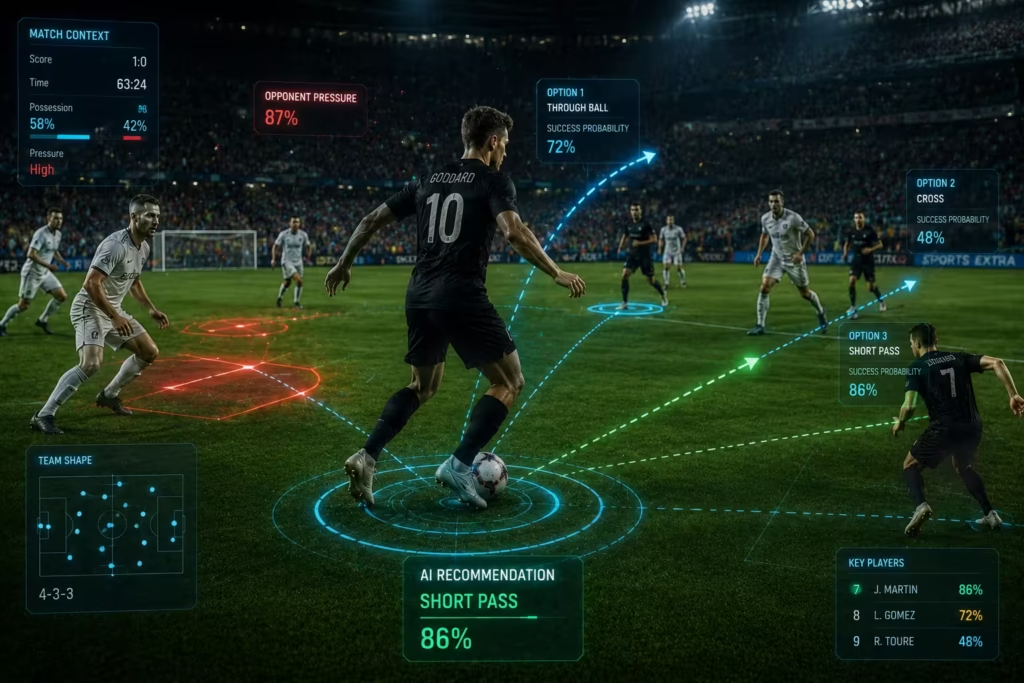
Artificial intelligence improves soccer decision-making by looking at where playersre, on the field how they are moving and what the other team is doing. This helps artificial intelligence suggest what players should do.
Just having a lot of information does not make soccer players better. Soccer players need to practice and learn how to use this information when they are playing a game. In the parts you will see how the best soccer teams use artificial intelligence insights to make faster and smarter decisions during a game.
But raw data alone doesn’t improve performance—players need specific training methods to apply these insights under match pressure. If you want to apply these concepts immediately, start with practical AI-based soccer training drills for decision-making
Why This Matters More Than You Think
Most players assume better decisions come from experience alone.
That’s no longer true.
Today, AI reveals:
- where you should pass before you even look up
- when to accelerate based on opponent fatigue
- Which spaces will open seconds in advance
But here’s the problem:
Most players still fail to apply this data in real matches.
How AI Improves Soccer Decision-Making in Real Matches
AI systems process thousands of data points per second, including:
- player positioning (GPS tracking)
- ball trajectory
- opponent pressure zones
- passing lane probabilities
Key Improvements AI Delivers
- Faster decision speed (reduced hesitation)
- Better spatial awareness
- Predictive passing instead of reactive play
- Improved off-ball movement
However, prediction accuracy drops significantly in high-pressure situations.
That’s why training adaptation—not just data—is what separates elite players.
Why Most Players FAIL Using AI Data
This is where nearly all content online stops—and gets it wrong.
Players fail because:
- they receive too much data without context
- they don’t train under realistic pressure
- they lack structured drills to apply insights
AI gives answers—but not habits.
Without training integration, performance doesn’t change.
How AI Enhances Game IQ: 4 Core Factors

1. Pattern Recognition
AI identifies recurring tactical patterns:
- opponent defensive shapes
- pressing triggers
- attacking gaps
Players trained with this data begin to:
- Anticipate plays earlier
- Make decisions before receiving the ball
2. Decision Speed Under Pressure
Reaction time is critical in soccer. Research from PubMed’s cognitive performance studies shows that faster processing leads to better performance outcomes in high-pressure environments.
AI models simulate match scenarios.
Example:
- 3 passing options
- 0.8 seconds to decide
Players trained with AI:
- react faster
- Choose higher success options
3. Spatial Awareness
AI heatmaps reveal:
- high-value zones
- dangerous spaces
- positioning mistakes
Knowing the space is useful—but timing movement is what actually creates advantage.
4. Off-Ball Intelligence
AI tracks movement without possession:
- runs that create space
- defensive positioning
- pressing angles
This is where game IQ increases the most.
How Players Actually Use AI Data in Training

This is the missing link most competitors ignore.
Example Training Flow:
Step 1: Data Analysis
- Review AI heatmaps
- Identify missed opportunities
Step 2: Scenario Simulation
- Recreate match situations
- Limit decision time
Step 3: Repetition Under Pressure
- Add defenders
- Increase speed
This converts AI insights into automatic decisions.
Case Study: AI Passing Decision Training
A professional-level training setup used:
- GPS tracking + AI analysis
- identified optimal passing window: 0.8 seconds
- simulated high-pressure scenarios
Result:
- 18% faster decision-making
- 22% improvement in pass accuracy
What made the difference was not just analysis but repetition under realistic pressure.
AI vs Human Decision-Making in Soccer
| Scenario | Human Decision | AI-Assisted Decision | Outcome Impact |
| Counter attack | reactive | predictive | faster execution |
| Passing | visual-based | probability-based | higher accuracy |
| Positioning | instinctive | data-driven | better spacing |
| Defense | delayed reaction | anticipatory | fewer errors |
Wearable Technology + AI Integration
Modern AI in soccer relies on:
- GPS trackers
- heart rate monitors
- motion sensors
These tools provide:
- fatigue analysis
- sprint optimization
- injury risk prediction
AI can also adjust recommendations based on real-time physical output, which adds another layer to decision-making.
How AI Improves Decision-Making During Matches
AI systems now assist:
- coaches (real-time tactical adjustments)
- analysts (performance breakdowns)
- players (post-match feedback)
However, players still need structured training to apply insights instantly during live play.
How You Can Apply AI Without Pro-Level Tools
You don’t need elite technology to benefit.
Simple approach:
- review match footage
- track your decisions manually
- identify patterns
- simulate scenarios in training
This builds AI-like thinking even without advanced software.
The Future of AI in Soccer Intelligence
AI is moving toward:
- real-time wearable feedback
- predictive coaching systems
- personalized training algorithms
Players who adapt early will gain a measurable competitive advantage.
FAQs: How AI Improves Soccer Decision-Making and Game IQ
Can AI improve soccer decision-making?
Yes—AI analyzes positioning, timing, and opponent behavior to suggest optimal actions.
However, applying these insights under pressure requires specific training methods.
Is AI used in professional soccer?
Yes—top clubs use AI for performance analysis, injury prevention, and tactical planning.
The real advantage comes from how players train using this data.
How does AI improve game IQ?
AI enhances pattern recognition, spatial awareness, and decision speed.
But most players fail because they don’t convert insights into training habits.
Can beginners use AI in soccer training?
Yes—basic video analysis can replicate AI-style learning.
The key is focusing on decision patterns, not just technique.
Does AI replace coaches in soccer?
No—AI supports coaches by providing data insights.
Coaching remains essential for applying those insights effectively.
Final Thoughts
In short, AI provides the roadmap, but repetitive, pressure-trained drills turn that roadmap into instinct.
The players who win are not the ones with access to AI but the ones who train their decisions using it.


