
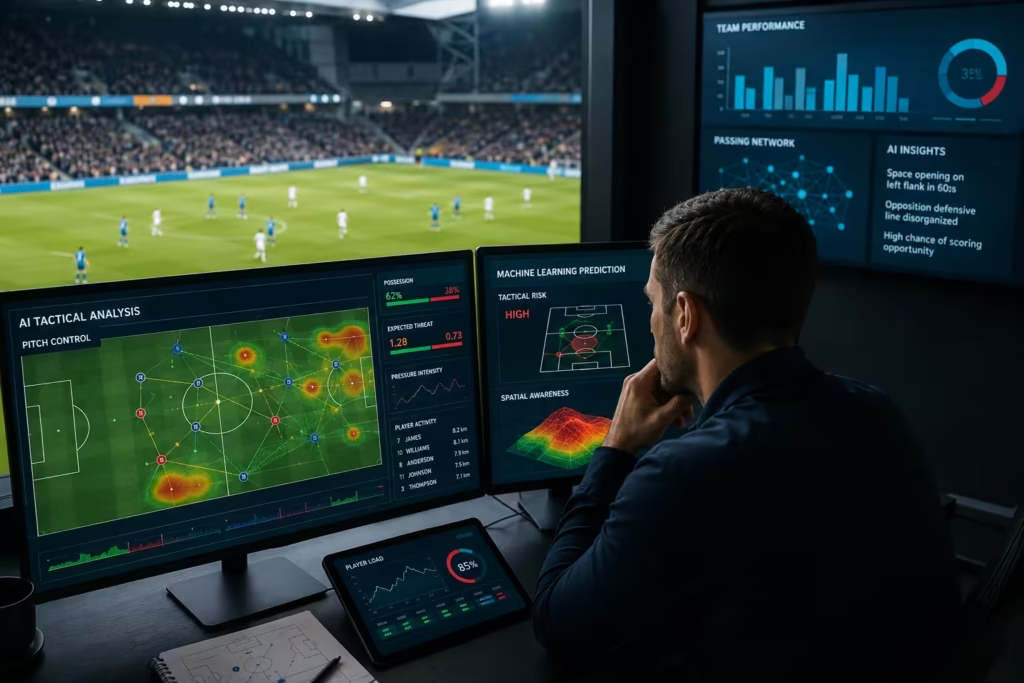

Game-Changing Machine Learning in Soccer Tactics & Spatial Awareness is transforming how modern soccer teams analyze positioning, predict tactical breakdowns, and make smarter decisions before problems appear on the pitch. Instead of relying solely on coaches’ observations or post-match video reviews, today’s AI-powered models identify hidden spatial patterns, evaluate player movement in real time, and reveal tactical weaknesses long before they lead to goals.
Most tactical breakdowns in soccer don’t happen because a player makes a bad decision in the moment. They happen because a gap opened up ninety seconds earlier and nobody—not the coach, not the analyst, nor the player—could see it forming in real time. That’s exactly the problem machine learning research has been built to solve, and over the last few years it has moved from academic conference papers into the training grounds of elite clubs such as Liverpool FC, Real Madrid, and Chelsea.
This isn’t a theoretical overview. Every insight below is supported by peer-reviewed research, published collaborations between leading AI researchers and professional clubs, or wearable technologies already being used in professional soccer. If you’re a coach, analyst, player, or sports technology enthusiast, these eleven developments will show how machine learning is reshaping tactical intelligence, spatial awareness, and decision-making in soccer throughout 2026.
Table of Contents 11 Game-Changing Machine Learning in Soccer Tactics
1. Pitch Control Models Reveal Space Before Defenders Can Close It
The foundational breakthrough behind AI-driven soccer tactics and spatial awareness is something called “pitch control”—a probabilistic model that calculates, for every point on the field at every moment, which team is most likely to win a ball played there first. Researcher Javier Fernández and Luke Bornn’s “Wide Open Spaces” framework, first presented at the MIT Sloan Sports Analytics Conference, quantifies exactly how much space a team creates away from the ball, not just what happens on it.
Tactical Failure It Prevents
Coaches traditionally judged spacing by eye, which means slow structural collapses—a fullback drifting too high, a double-team leaving the weak side exposed—often go unnoticed until a goal is conceded. Pitch control turns that blind spot into a live, color-coded map.
How it works in practice: The model treats player velocity, reaction time, and distance to the ball as inputs, then outputs a probability surface across all 105×68 meters of the pitch. William Spearman extended this into “pitch value,” which weights space by how dangerous it is, not just how much of it exists.
These predictive models are becoming a major reason AI is improving on-field decisions. If you want to see how machine learning helps players choose better passes, movements, and positioning under pressure, read our detailed guide on How AI Improves Soccer Decision-Making and Game IQ in 2026.
2. Graph Neural Networks Are Rewriting Set-Piece Strategy
The clearest real-world proof that machine learning is reshaping soccer tactics and spatial awareness is TacticAI, a system Google DeepMind built with Liverpool FC over a multi-year collaboration and published in Nature Communications in 2024. TacticAI models a corner kick as a graph—players as nodes, spatial relationships as edges—using geometric deep learning to predict who’s most likely to receive the ball and whether a shot follows.
Tactical Failure It Prevents
Set pieces are rehearsed but under-analyzed because they only occur roughly ten times per match, leaving coaches with too little data to spot which marking assignments consistently break down.
The proof it works: When Liverpool’s own analysts were shown TacticAI’s suggested repositioning against real historical corner setups—without knowing which was which—they preferred the AI’s recommendation over what the team actually did 90% of the time, across 50 tested scenarios. DeepMind researcher Petar Veličković has noted that clubs are likely to start experimenting with techniques like this directly on the training pitch.
DeepMind’s TacticAI provides tactical insights on corner kicks through combined predictive and generative AI, built on five years of collaboration with Liverpool FC that began with a paper on why AI should assist football tactics and continued through a 2022 system called Graph Imputer that could predict off-camera player movement without tracking data.
3. GPS-Driven Injury Forecasting Flags Load Spikes Before Tactical Collapse
A tired team is a tactically compromised team—spacing narrows, recovery runs slow down, and pressing triggers get missed. That’s why GPS-based machine learning injury forecasting is one of the most directly actionable branches of this field. A widely cited study published in PLOS ONE used decision-tree machine learning on GPS training-load data from a professional soccer club and built a forecaster that, once trained on in-season data, achieved a cumulative F1-score of 0.60 on predicting injury class — enough to help the club prevent more than half of that season’s non-contact injuries.
These prediction models depend heavily on metrics such as sprint distance, high-speed running, accelerations, decelerations, and player load. If those numbers are unfamiliar, our Football GPS Metrics Explained 2026 guide breaks down every important metric in simple language.
Tactical Failure It Prevents
Losing a key structural player—a holding midfielder, a covering center-back—mid-match or mid-season forces improvised spacing that opposition scouts exploit immediately.
Supporting evidence: A separate peer-reviewed study on English Premier League players found acute sprint distance and acute high-speed-running distance acted as protective factors against non-contact muscle injury, while spikes in acute peak speed and chronic total distance significantly raised risk — with the resulting predictive model reaching an AUC-ROC of 0.80.
4. Wearable Sensor Fusion Exposes Fatigue Before It Becomes a Positioning Error
Modern GPS vests don’t just track distance—they fuse accelerometer, heart-rate, and player-load data at high sampling rates to build a real-time fatigue profile. Catapult’s systems and STATSports’ Apex units, both used across professional and academy soccer, sample motion data at rates up to 18Hz for positioning and 952Hz for the built-in accelerometer, capturing micro-fluctuations in output that precede visible fatigue. Choosing reliable tracking hardware is equally important. We’ve compared the Best GPS Trackers for Football Players based on accuracy, sampling rate, battery life, and overall value.
GPS vests are only one part of the wearable technology revolution. Our complete guide to 10 Proven Benefits of Wearable Tech in Soccer Training explains how smart sensors improve conditioning, injury prevention, recovery, and tactical awareness.
Tactical Failure It Prevents
Fatigue-driven tactical failure is one of the most common in-match breakdowns—a fullback who covered every overlap in the first half stops tracking runners in the second, and the opposition’s data-savvy analysts already know exactly when to target that flank.
Real-world outcome: One major European club using STATSports‘ system reported a 50% reduction in soft-tissue injuries — from 44 down to 22 — in its very first season of adoption, a change directly tied to using training-load data to adjust match-day rotations and training intensity.
5. Computer Vision Maps Every Player’s Spatial Relationship in Real Time
Where GPS vests measure physical output, computer-vision systems—the kind used in Metrica Sports-style dashboards—track spatial relationships: distances between players, team shape, and coverage areas, alongside ball trajectory and speed, without requiring any wearable hardware at all. These AI-powered analytics dashboards provide real-time insight into player positioning and tactical patterns, tracking spatial relationships like distances between players, team shape, and coverage areas alongside ball position, trajectory, and speed.
Even the most advanced tracking device won’t deliver useful analytics if it’s configured incorrectly. Our step-by-step guide on How to Use a GPS Tracker shows beginners how to collect accurate performance data safely.
Tactical Failure It Prevents
Machine learning algorithms process this volume of data to detect patterns invisible to the human eye—for example, how a midfielder tends to drift wide under pressure, which spaces a defender, leaving them exposed during quick transitions, or which zones a striker is most effective in when receiving the ball. Without computer vision, these micro-patterns simply go unrecorded, and the same structural weakness can be exploited match after match before anyone notices the trend.
6. Formation-Detection Algorithms Catch Structural Breakdowns Before They Become Goals

Teams don’t hold a rigid 4-3-3 or 4-2-3-1 for 90 minutes—formations flex, roles rotate, and structure quietly degrades under pressure. Machine learning methods like SoccerCPD, presented at the ACM SIGKDD conference, use spatiotemporal tracking data to automatically detect formation and role change points during a match, rather than relying on a human analyst to spot the shift after the fact.
Tactical Failure It Prevents
A back four sliding into an accidental back three, or a midfield losing its double-pivot without the coaching staff registering it in real time, are exactly the kind of structural failures that lead directly to conceded goals—and formation-detection models flag them as they happen, not at halftime video review.
7. Predictive Models Score Passing Options by Space Created, Not Just Completion Rate
Traditional stats reward a five-yard sideways pass with a 99% completion rate the same as a line-breaking through-ball that unlocks a defense. Space-creation models—building on Fernández and Bornn’s original framework—instead score a pass, run, or off-ball movement by how much dangerous space it generates for teammates, independent of whether the ball is even touched.
Tactical Failure It Prevents
Coaches who only track completion percentage can mistake a possession-heavy, low-risk team for a tactically sound one, missing the fact that the team is failing to progress the ball into threatening zones—a pattern that shows up as “control without creation” and predicts scoring droughts well before they happen.
8. Sprint and Acceleration Analytics Personalize Positional Training
Boot-mounted sensors like Playermaker sample motion data at 1,000 times per second directly from the foot, tracking sprint distance, acceleration and deceleration, change-of-direction load, and time-on-ball — data that chest-worn GPS units, focused mainly on running distance and top speed, simply can’t capture. A controlled training study found that real-time, drill-specific wearable feedback produced a 17.33% improvement in sprint speed and a 10.21% improvement in passing accuracy over an eight-week intervention, with the control group showing no comparable gains.
Tactical Failure It Prevents
Generic, one-size-fits-all conditioning programs often under-train the specific movement patterns a player’s position actually demands, leaving wingers under-conditioned for repeat sprints or center-backs under-prepared for recovery runs—precisely the gaps opposition analysts look for.
9. Reinforcement Learning Simulates Tactical “What-Ifs” Before Matchday
Beyond describing what already happened, newer research applies multi-agent reinforcement learning to simulate what could happen—testing alternative pressing triggers, defensive lines, or build-up patterns against a model of the opponent before a ball is kicked. Academic work using inverse reinforcement learning has been applied to infer both offensive and defensive strategic intent directly from tracking data, effectively reverse-engineering a rival’s tactical logic.
Tactical Failure It Prevents
Walking into a match with a fixed game plan that doesn’t account for how the opponent will actually adapt is one of the most common sources of second-half tactical failure. Simulation-based approaches let a coaching staff pressure-test a plan against multiple opponent responses in advance.
10. AI-Driven Scouting Predicts Rival Formations and Spatial Weak Points
The same spatiotemporal tracking techniques used to analyze a coach’s own team can be pointed at upcoming opponents, building formation histories, space-creation tendencies, and set-piece patterns from historical match data. This shifts opposition scouting from a handful of manually reviewed clips to a systematic, data-driven profile of exactly where a rival is spatially vulnerable.
Tactical Failure It Prevents
Under-scouted opponents are a classic source of tactical failure — a team that always overloads the same half-space on corners, or consistently leaves a specific channel open in transition, will keep getting exploited by any club that has actually modeled the pattern instead of relying on a scout’s memory of the last meeting.
11. Integrating GPS, Video, and ML Into One Dashboard Is the Real Differentiator
The clubs getting the most value from soccer’s AI and spatial-tracking tools aren’t necessarily using the most exotic algorithm — they’re the ones who’ve unified GPS load data, boot-sensor technical data, and computer-vision spatial data into a single dashboard that coaching staff can actually read in five minutes between sessions. Most existing systems still specialize in one lane: physical output (Catapult, STATSports), technical/ball-touch data (Playermaker), or tactical spatial modeling (Metrica, TacticAI-style research tools) — rarely all three at once.
Tactical Failure It Prevents
Fragmented data is the quiet failure mode behind most of the other ten insights on this list — a club can have excellent injury-forecasting data and excellent spatial-tracking data and still miss a preventable failure simply because the two systems never talk to each other. Integration, not raw model sophistication, is increasingly the actual competitive edge.
Building this kind of integrated ecosystem requires choosing the right AI-powered platforms. If you’re comparing today’s leading solutions, our guide to Best AI Soccer Training Systems: 8 Proven Technologies That Improve Performance explains which technologies combine GPS tracking, computer vision, wearable sensors, and tactical analytics most effectively.
The Takeaway on Machine Learning in Soccer Tactics & Spatial Awareness
No single tool on this list is a silver bullet. Pitch control models, TacticAI-style set-piece systems, GPS injury forecasting, and boot-mounted technical sensors each solve a different piece of the same underlying problem: tactical failures are almost always spatial and predictable before they’re visible. The clubs and coaches getting ahead aren’t chasing the newest algorithm — they’re building the discipline to actually act on what these systems already flag.
Machine learning delivers the best results when combined with proven training equipment. We also reviewed several Game-Changing Soccer Training Tools that complement AI analysis and accelerate player development.
Comparison Table: Popular ML-Powered Tracking Systems in Soccer
| System | Primary Data Captured | Sampling Rate | Best Suited For |
| Catapult (Vector/One) | GPS position, distance, player load, acceleration | Up to 18Hz GPS | Professional/academy physical load monitoring |
| STATSports Apex | GPS position, heart rate, sprint/HSR distance | 10–18Hz GPS, 952Hz accelerometer | Injury-risk load management |
| Playermaker | Ball touches, kicking velocity, technical metrics | 1,000Hz motion sampling | Technical and tactical individual development |
| Metrica Sports (computer vision) | Player/ball spatial position, pitch control | Frame-by-frame video | Tactical shape and space analysis without wearables |
| TacticAI-style GNN research models | Set-piece player graphs, outcome prediction | Event/tracking-data dependent | Set-piece and structured-phase tactical planning |
If you’re just starting with player tracking, you don’t need professional-level equipment. Our review of the Best Budget Entry-Level GPS Trackers Under $100 highlights affordable devices that provide reliable movement data for coaches, players, and small clubs.
Frequently Asked Questions
How does wearable tech improve sprint speed in soccer? Wearable sensors give time-specific feedback during drills. This allows players and coaches to fix mechanics and how fast they run while the session is happening. It does not wait until after the session to review. A study that was controlled showed this method led to a 17.33% increase in speed in eight weeks. The same study also showed improvements in agility and shot power.
Can machine learning actually predict soccer injuries? Not in a way that’s 100 percent certain, but it can be quite accurate. Research that has been checked by experts and uses GPS training-load data along with decision-tree machine learning has created tools that can predict injuries. These tools have F1-scores of 0.60 and AUC-ROC values as high as 0.80. This level of accuracy is enough to help clubs reduce contact injuries when they take action based on the warnings these tools provide.
What is pitch control in soccer analytics? Pitch control is a machine learning model that calculates the probability each team would win a ball played to any given point on the field at any given moment, turning spatial awareness into a measurable, visual map rather than a subjective read.
Do professional clubs really use AI for tactics, or is it still experimental? It’s in active professional use. Liverpool FC’s multi-year collaboration with Google DeepMind produced TacticAI, a corner-kick tactics system published in Nature Communications, and wearable systems from Catapult, STATSports, and Playermaker are already standard equipment across professional and academy soccer.
What’s the biggest current gap in machine learning in soccer tactics and spatial awareness? Integration. Most clubs run separate systems for physical load (GPS vests), technical data (boot sensors), and tactical spatial modeling (computer vision), and the biggest performance gains are increasingly coming from unifying those data streams rather than adopting any single new algorithm.
About the Author
This article was produced by the Sports Wink editorial team, which specializes in data-driven football and soccer analysis, drawing on peer-reviewed sports science research, published AI research from labs including Google DeepMind, and performance data from professional-grade wearable systems used by clubs and academies worldwide. Every statistic in this piece is sourced from a cited, verifiable publication — no figures are estimated or invented.


